


What is Bitcoin? A complete guide to the world's leading crypto
 23 min read
Bitcoin is a payment network and a monetary asset that runs without a bank, a company or a government at the centre of it. Since it started in 2009 its rules have never been changed, and it is now worth more than $1.6T. This guide explains how it works, in plain language.
Bitcoin is the world's first decentralised digital currency. It was described in a nine-page document, the Bitcoin whitepaper, published in October 2008 by a person or group using the name Satoshi Nakamoto, and the network went live in January 2009. Nobody knows who Satoshi is, and nobody needs to: the software is open source, which means anyone can read it, and nobody can change it on their own.
Two things make bitcoin different from the money in your bank account. The first is that no institution issues it or controls it. There is no board, no central bank and no company that can freeze a balance or create more of it. The second is that the total quantity is capped. There will only ever be 21M bitcoin, and that number is written into the software that every participant runs.
It helps to be clear about what the network itself is. Bitcoin is a financial network, and its function is settling transactions: moving value from one holder to another and recording that the transfer happened. It has been available 99.98% of the time since it started in 2009, with two documented interruptions and none since 2013.1 And no one leads it. There is no chief executive, no head office and no opening hours. Availability is produced by thousands of independent operators competing to process transactions, which is also why the network cannot be switched off by a single decision. For a system with no staff and no premises, that record of continuous availability is a genuinely striking one, and it is usually the fact that shifts bitcoin from a market story to an infrastructure story. It says nothing on its own about whether the asset is worth owning. That is a separate question, and worth discussing.
As at 3 September 2026, bitcoin trades at $81,300 and the total value of all bitcoin in existence is $1.63T.2 That makes it comfortably the largest digital asset in the world, and it is the only one most investors will ever need to understand in detail, because almost everything else in the sector is built in reference to it.
Key takeaways
Bitcoin is a decentralised digital currency with a fixed supply of 21M coins. No government or institution can create more of it.
Every transaction is recorded on the blockchain, a public ledger maintained simultaneously by thousands of independent computers around the world.
New bitcoin is created through mining, a process that consumes electricity and is deliberately expensive. That expense is what makes the ledger hard to tamper with.
The rate of new supply halves roughly every four years, an event called a halving. The last was in April 2024 and the next is expected in April 2028.
Investors can buy bitcoin directly on an exchange, or gain exposure through regulated products such as a bitcoin exchange traded product (ETP), without holding the asset themselves.
Bitcoin at a glance
Decentralisation
Bitcoin runs on a network of computers, called nodes, that talk directly to each other rather than through a central server. Each node keeps its own complete copy of the transaction history and independently checks that every new transaction obeys the rules. Public crawlers can see between 20k and 25k of these nodes at any given moment, and the real number is higher because many run behind home firewalls where they cannot be counted.2
This matters for a practical reason. If a single company ran the ledger, that company could be pressured, hacked or shut down. Because thousands of independent copies exist, there is nothing to shut down. It also means the rules cannot be quietly rewritten: a change only takes effect if the people running the software choose to adopt it.
Security
Every bitcoin transaction is signed using cryptography, a branch of mathematics that proves a message came from the person who claims to have sent it and that nobody altered it along the way. Only the holder of the right key can spend a given bitcoin, and anyone can verify that signature without ever seeing the key.
Transactions are then grouped into batches called blocks, and each block carries a short fingerprint of the block before it. That is where the word blockchain comes from. The fingerprint is calculated so that altering anything at all in the earlier block, down to a single digit, produces a completely different result. Cryptography therefore makes tampering immediately visible to everyone. What it does not do is make tampering expensive.
That part comes from the electricity. A block is only accepted if its fingerprint was found through the guessing process described below, which burns real power on real hardware. An attacker wanting to change a transaction from last week would have to buy all of that electricity again, for the block it sits in and for every block since, and outpace the rest of the world while doing it. Cryptography tells everyone the history has been altered. The cost of the power is what makes altering it not worth attempting.
A fixed supply
There will never be more than 21M bitcoin. That is 21M coins, not 21M dollars' worth, and it is the point of the whole design. Of that total, 20.08M have already been issued, leaving less than 5% still to come.2
This scarcity is often compared to gold, which is why bitcoin is sometimes called digital gold. The comparison is imperfect, because more gold can always be mined if the price rises high enough, whereas bitcoin's issuance schedule does not respond to demand at all. One bitcoin can be divided into 100M units called satoshis, so the fixed cap does not prevent small transactions.
Open access
There is no application form. Anyone with an internet connection can create a bitcoin wallet, receive funds and send them, with no credit check, no minimum balance and no geographic restriction. That same openness creates the risks the sections below set out, and it is genuinely valuable to people in countries with capital controls, unstable currencies or limited access to banking.
How Bitcoin works
Proof of work
Bitcoin uses a system called proof of work to decide who gets to add the next page to the ledger. Computers around the world compete to solve a puzzle that has no shortcut: the only way to solve it is to guess, billions of times a second, until one of them stumbles on an answer that fits. Each guess is called a hash. The first computer to find a valid answer publishes the new block, and everyone else checks it in an instant and moves on.
The puzzle is calibrated so that, on average, one block is found every ten minutes. Roughly every two weeks the network automatically adjusts the difficulty of the puzzle up or down to keep that ten-minute rhythm, whatever number of machines are competing.
The total guessing power aimed at the puzzle is called the hashrate. Bitcoin's currently sits at 930 exahashes per second on a thirty-day average.2 An exahash is a quintillion hashes, which is a one followed by eighteen zeros, so the network is collectively making 930 quintillion guesses every second. The figure is worth watching for one reason only: the higher it is, the more electricity and hardware an attacker would need to muster in order to overpower the honest participants. It currently sits roughly a fifth below the peak it reached in October 2025, and it has stayed below that peak for 316 days. The reason is not that bitcoin is being abandoned. Some miners have redirected part of their electricity supply away from bitcoin and into running artificial intelligence and other high-performance computing work, which currently pays them more.
Mining
The computers doing the guessing are called miners, and the process is called mining. It is a business, not a hobby. Miners buy specialised machines, pay for electricity and compete for a reward paid in bitcoin.
That reward has two parts. The first is the block subsidy: brand new bitcoin created by the software and handed to whoever found the block. It is currently 3.125 bitcoin per block, or 450 new bitcoin a day. The second is transaction fees, paid by users who want their transactions included.
The balance between the two is the most important number in bitcoin economics, and it is heavily lopsided today. Across calendar year 2025, users paid $173M in transaction fees while miners received $16.9B worth of newly issued bitcoin.2 That is close to $100 of new issuance for every $1 paid by the people actually using the network. Because issuance halves every four years and eventually stops, fees will have to carry more of that load over time. How quickly they grow is a genuine open question, and we return to it in the analysis below.
The blockchain
The blockchain is simply the record of every bitcoin transaction ever made, from the first block in January 2009 to the one being mined right now. It is public. Anyone can download it, inspect it and verify it, without asking permission and without trusting anyone else's copy.
Bitcoin processed 153.7M transactions across calendar year 2025, an average of 421k a day, and it is running at 567k a day so far in 2026.2 By the standards of a card network that is modest. Bitcoin's base layer was designed for final settlement of value rather than for buying coffee, which is why a faster payments layer called the Lightning Network was built on top of it, and why most everyday activity happens either there or at exchanges rather than on the blockchain itself.
Halvings
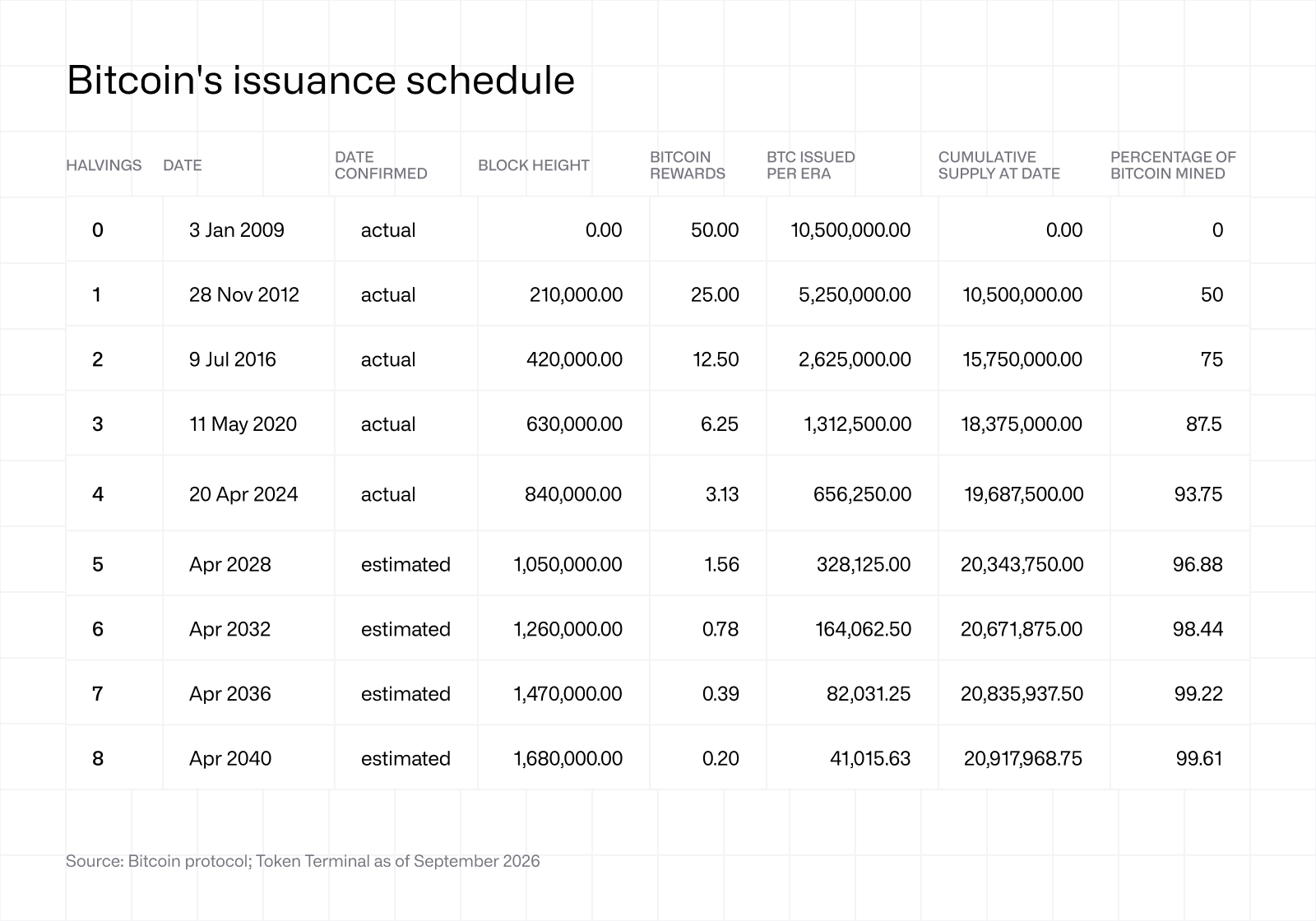
Bitcoin's supply is released on a schedule that tightens automatically. Every 210,000 blocks, which works out at roughly four years, the block subsidy is cut in half. This event is called a halving.
The subsidy started at 50 bitcoin per block in 2009. It fell to 25 in 2012, 12.5 in 2016, 6.25 in 2020 and 3.125 at the fourth halving on 20 April 2024.2 The next is expected around April 2028, when it will drop to 1.5625. The halvings continue until the subsidy rounds down to zero, at which point the 21M cap will effectively have been reached. That is projected to happen around 2140, and miners will then be paid entirely from transaction fees.
The practical effect today is that bitcoin's annual supply growth is 0.8%, and it will fall to 0.4% after 2028. Investors often expect a halving to push the price up, on the reasoning that supply falls while demand does not. That is a plausible mechanism, but there have only been four halvings in bitcoin's history, which is far too small a sample to treat as a rule.
History and milestones
Bitcoin's first decade was a technology story. Its second has been a financial one.
2008. The Bitcoin whitepaper is published under the name Satoshi Nakamoto, describing a payment system that works without a trusted intermediary.
2009. The network launches. The first block is mined on 3 January.
2010. The first documented commercial transaction: a programmer pays 10k bitcoin for two pizzas.
2013. Bitcoin's total market value passes $1B for the first time. It ends the year at $768.2
2014. Mt. Gox, then the largest exchange, collapses after the loss of around 850k bitcoin. It is the sector's formative lesson in the difference between owning bitcoin and trusting somebody else to hold it for you.
2016 and 2020. The second and third halvings cut the block subsidy to 12.5 and then 6.25 bitcoin.
2018. The Lightning Network launches on the main bitcoin network, adding a layer for fast, low-cost payments.
2021. El Salvador becomes the first country to make bitcoin legal tender. Bitcoin reaches $69,000 in November, a record that stands for three years.
January 2024. The US Securities and Exchange Commission approves eleven spot bitcoin exchange traded funds, which hold bitcoin directly rather than tracking it through derivatives, allowing American investors to buy bitcoin exposure through an ordinary brokerage account for the first time.3 It is the single largest change in how institutions access bitcoin.
April 2024. The fourth halving cuts the block subsidy to 3.125 bitcoin.2
March 2025. A US executive order establishes a Strategic Bitcoin Reserve, consolidating bitcoin already held by the federal government under Treasury management and directing that it not be sold.3
July 2025. The GENIUS Act is signed into law in the United States, the country's first federal statute covering a category of digital assets.3
October 2025. Bitcoin sets a new all-time high of $126,200 on 6 October.2
2026. US spot bitcoin funds hold close to $97B of assets, and listed companies together hold more than 5% of all bitcoin in existence.2, 4
The pattern worth taking from that list is that the technology has been remarkably stable while everything around it has changed. Bitcoin's monetary rules in 2026 are identical to its rules in 2009. What has changed is who owns it, how they buy it and what the law says about it.
What's next
Three things are worth watching over the next few years.
The 2028 halving. In April 2028 the block subsidy falls to 1.5625 bitcoin and annual supply growth drops to 0.4%. Halvings are the only pre-scheduled events in bitcoin, so they are the clearest fixed point on the calendar.
The fee question. Every halving cuts the subsidy in half, so over decades the cost of securing the network has to migrate from new issuance to transaction fees. On 2025 figures, fees are a rounding error next to the subsidy. This is not an imminent problem, because the subsidy remains large in dollar terms, but it is the structural issue that bitcoin has to solve eventually, and it is more interesting than anything happening to the price.
Regulatory maturation. In the European Union, the Markets in Crypto-Assets Regulation (MiCA) has been fully in force for crypto service providers since December 2024, giving firms a single licensing regime across the bloc.3 In the United States, the CLARITY Act, which would divide oversight of digital assets between the two main market regulators, cleared Senate markup in May 2026 but is not yet law.3 Clearer rules tend to widen access rather than narrow it, which has been the direction of travel since 2024.
How to get exposure to bitcoin
There are three broad routes, and they differ mainly in who is responsible for keeping the asset safe.
Buying and holding it yourself. You open an account at a crypto exchange, buy bitcoin, and ideally move it to a wallet you control. A wallet does not really hold coins; it holds a private key, which is a secret number that authorises spending. Whoever has the key has the bitcoin. This gives you the most direct ownership and the most responsibility: lose the key and the funds are gone permanently, with no helpline and no recovery process.
Leaving it on an exchange. Simpler, and how most people start, but you are trusting a company to hold the asset on your behalf. The Mt. Gox collapse in 2014 and the failure of FTX in 2022 are the two reference points here.
Regulated exchange traded products. An ETP is a security that trades on a stock exchange like a share and tracks the price of an underlying asset. A physically backed bitcoin ETP holds actual bitcoin with a professional custodian, a regulated firm whose only job is safekeeping, and you buy it through your existing brokerage or bank account using an ISIN, the standard code your broker uses to identify a security, just as you would an equity or a fund. You do not manage keys and you do not open an account with a crypto exchange.
CoinShares issues the CoinShares Bitcoin ETP (ticker BITC, ISIN GB00BLD4ZL17), which is physically backed and carries a management fee of 0.15% a year, alongside longer-established bitcoin trackers listed in Sweden in Swedish krona and in euro. Fees, structure and the applicable risks are set out in the prospectus and key information document, which should be read before investing.
How much?
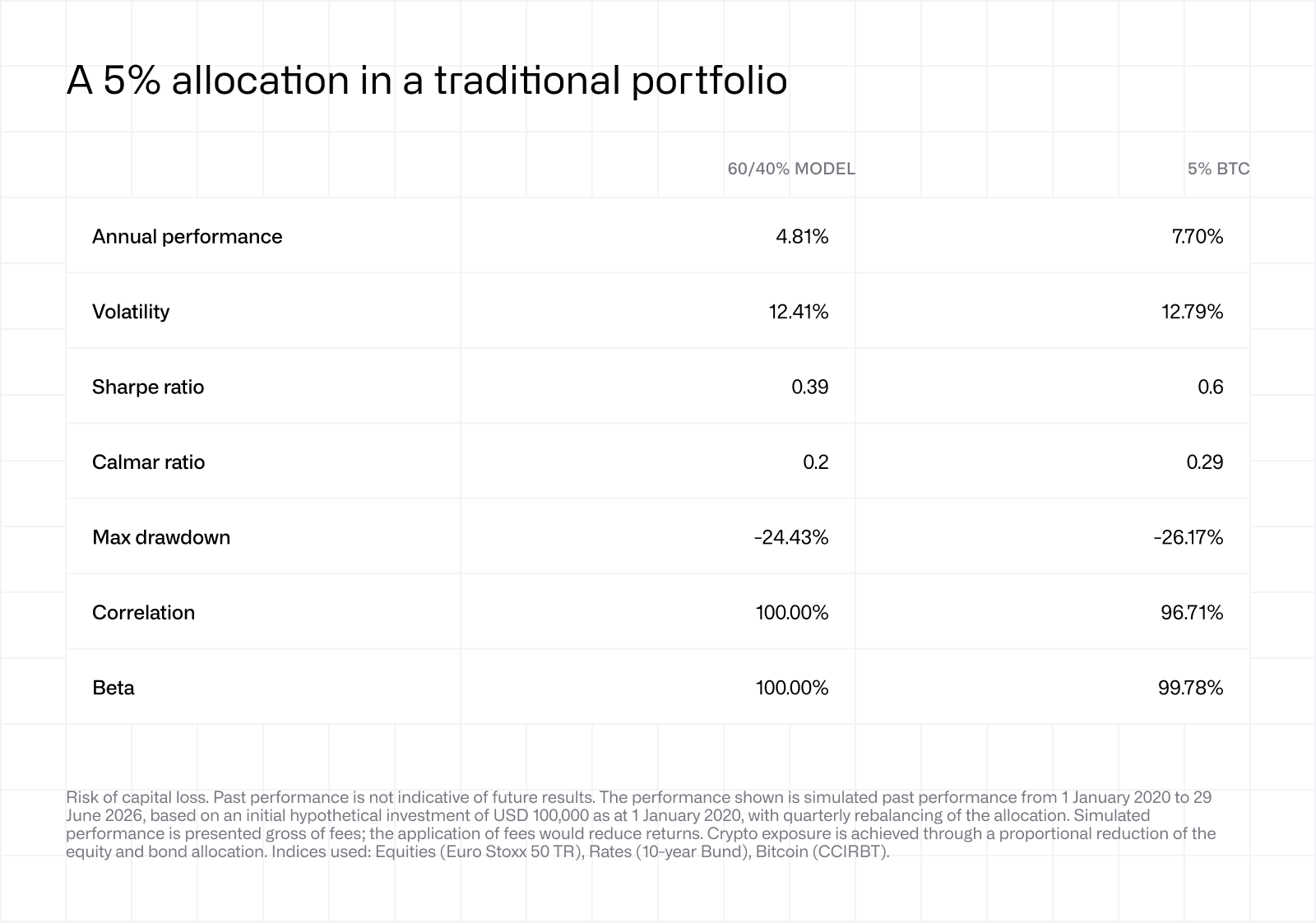
Our portfolio allocation model looks at what happens when a small bitcoin sleeve is added to a traditional multi-asset portfolio. A portfolio with no digital assets returned 4.8% a year with 12.3% volatility, a Sharpe ratio of 0.39 and a maximum drawdown, meaning the worst peak-to-trough fall over the period, of 24.1%. Adding a 5% bitcoin-only sleeve raised the annual return to 8.2% and the Sharpe ratio to 0.67, while volatility was essentially unchanged at 12.2% and the maximum drawdown widened modestly to 25.7%. The Sharpe ratio measures return per unit of risk, so a higher number means the extra return was not simply bought with extra volatility. That 5% is a digital asset allocation, and it is not a slot that an equity fund with crypto-related holdings can fill, because those are different exposures. The point is not that 5% is the right answer for everyone. It is that at small weights, bitcoin's contribution to portfolio risk is far smaller than its own volatility would suggest.Investors' capital is at risk and they may lose part or all of their investment. Crypto ETPs are complex products and may be difficult to understand. Past performance is not a reliable indicator of future returns. Refer to the prospectus and the relevant key information documents before investing.
CoinShares' analysis
Bitcoin has many possible uses, but the one that determines its value is its use as money. Its design optimises for the monetary properties that matter: scarcity, durability, divisibility, portability and resistance to seizure. Our view is that bitcoin becomes more valuable as it becomes more widely held and more widely accepted, because a monetary asset's usefulness grows with the size of the network that recognises it. Adoption, not technology, is the variable to watch.
Strengths
Four things do most of the work. No single company, government or individual controls the network, so there is no single point of failure that can bring it down. The supply cap has proved credible: there will never be more than 21M bitcoin, and across four halvings since 2009 the schedule has never been altered, which makes that predictability an asset in itself. Anyone can run the software, keep their own copy of the ledger and check the entire history independently, without trusting an auditor, a custodian or a regulator. And at a $1.63T market capitalisation, bitcoin is by a wide margin the most liquid digital asset, which matters to anyone who needs to buy or sell in size.2
Opportunities
What has changed most recently is access. US spot bitcoin funds hold close to $97B, from a standing start in January 2024, and European ETPs give the same access through an ordinary brokerage account, so the practical barrier to institutional ownership has largely gone.4 Ownership has broadened with it: listed companies together hold more than 5% of all bitcoin, and the US Strategic Bitcoin Reserve turned a government holding into an explicit policy position rather than an accident of asset forfeiture.3, 4 On the payments side, the Lightning Network moves transactions off the main ledger and makes them fast and cheap enough for everyday amounts, which is the layer where consumer use is most likely to grow. And for a portfolio, bitcoin's returns have historically not moved in lockstep with equities or bonds, which is why a small allocation improved risk-adjusted returns in our modelling.
Weaknesses
The obvious one is volatility. Bitcoin fell roughly 50% from its October 2025 high within four months, and it still trades more than a third below that high.2 Falls of that size are a normal feature of the asset rather than an anomaly, and they make it unsuitable for money you may need at short notice. The base layer is also slow by design: bitcoin settles a few hundred thousand transactions a day, which keeps the ledger small enough for ordinary people to verify but rules it out as a mass consumer payment network on its own. The deeper issue is the one set out above, that in 2025 users paid roughly $1 in fees for every $100 the software issued to miners.2 That is comfortable while the subsidy is large, but it is the long-term structural weakness in the design and it will not resolve itself. And despite one national experiment with legal tender, bitcoin has been used overwhelmingly as an asset to hold rather than a currency to spend.
Threats
Rules are getting clearer, but they are not converging: a framework that widens access in one jurisdiction can restrict it in another, and tax treatment varies widely between countries. Holding bitcoin yourself carries its own risk, because the property that makes it resistant to confiscation, that only the key holder can spend it, is the same property that makes loss irreversible. A forgotten password or a failed device destroys the funds outright. Leaving it with an intermediary swaps that for counterparty risk, which is what Mt. Gox and FTX were, and neither had anything to do with a flaw in bitcoin itself. Proof of work also consumes electricity by design, and where that draws political attention it can translate into restrictions on mining and, indirectly, into pressure on where the network's operators are based. Finally, other networks offer capabilities bitcoin does not, particularly programmable applications. Bitcoin's answer is that it is not trying to do those things, but the competition for capital and attention is real.
Where that leaves an investor
Bitcoin's rules have not changed since it started in 2009. What has changed is who holds it, how they buy it and what the law says about it, and that shift, rather than the technology, is what an investor is actually taking a view on. The practical question is therefore not what bitcoin will be worth next year but what size of position makes a 50% fall survivable: at a 5% weight, halving the position costs the portfolio 2.5%, which is a bad quarter rather than a broken plan. Decide that number first. Then choose the route, holding it yourself, leaving it with an exchange, or a regulated ETP, on the basis of who you want responsible for keeping it safe.
Frequently asked questions
What is bitcoin in simple terms?
Bitcoin is digital money that works without a bank. Transactions are recorded on a public ledger, the blockchain, that thousands of independent computers keep and check simultaneously, so no single institution has to be trusted. The supply is capped at 21M coins and the rules are enforced by software rather than by an organisation.
How many bitcoin are there?
The maximum is 21M coins. Of those, 20.08M have been issued so far, leaving less than 5% still to come.2 The remainder is released gradually through mining, at a rate that halves every four years, and the last fraction will not be issued until around 2140.
When is the next bitcoin halving?
The fifth halving is expected around April 2028, at block 1,050,000, when the reward for mining a block falls from 3.125 bitcoin to 1.5625. The exact date cannot be fixed in advance because it depends on how quickly blocks are found. The previous halving was on 20 April 2024.2
Is bitcoin a good investment?
That depends entirely on your circumstances, your time horizon and your tolerance for loss. Bitcoin has produced strong long-term returns and has also fallen by more than half on several occasions, including this year. Our modelling suggests a small allocation has historically improved a diversified portfolio's risk-adjusted returns, so the useful starting point is the size of position you could hold through a fall of that kind. Past performance is not a guide to future performance and capital is at risk.
How can I invest in bitcoin without buying it directly?
Through a regulated exchange traded product. A physically backed bitcoin ETP holds bitcoin with a professional custodian and trades on a stock exchange, so you can buy it through your existing broker or bank using an ISIN, without opening a crypto exchange account or looking after a private key yourself.
Who created bitcoin?
A person or group using the pseudonym Satoshi Nakamoto, who published the Bitcoin whitepaper in October 2008 and launched the network in January 2009, then stopped communicating publicly in 2011. Their identity has never been established. Because the software is open source and the rules are enforced by everyone running it, bitcoin does not depend on its creator.
Sources
Bitcoin uptime tracker, as of 4 September 2026
Token Terminal, latest data as at 3 September 2026; CoinWarz, as of 4 September 2026
US Securities and Exchange Commission, 2024 to 2026
SoSoValue and Farside Investors, BitcoinTreasuries.net
Published onSept 15th, 2026