

Bitcoin 13F Q2 2026 report
 3 min read
Bitcoin 13F Q2 2026: Professionals hold firmer as the wider market sells off
Professional ownership held up in Q2 while the wider market sold. 13F filers reported 264k BTC equivalent at the end of June, up from 261k in Q1 (+1.3%), even as the US spot ETFs' total bitcoin holdings fell 6.3% and non-13F holders cut theirs by 8.3%. The dollar value of filer holdings fell 13% to $15.5B, driven by a 14% drop in bitcoin's price. The 13F share of total US bitcoin ETF AUM rose from 20.8% to 22.4%, the first increase since Q2 2025.
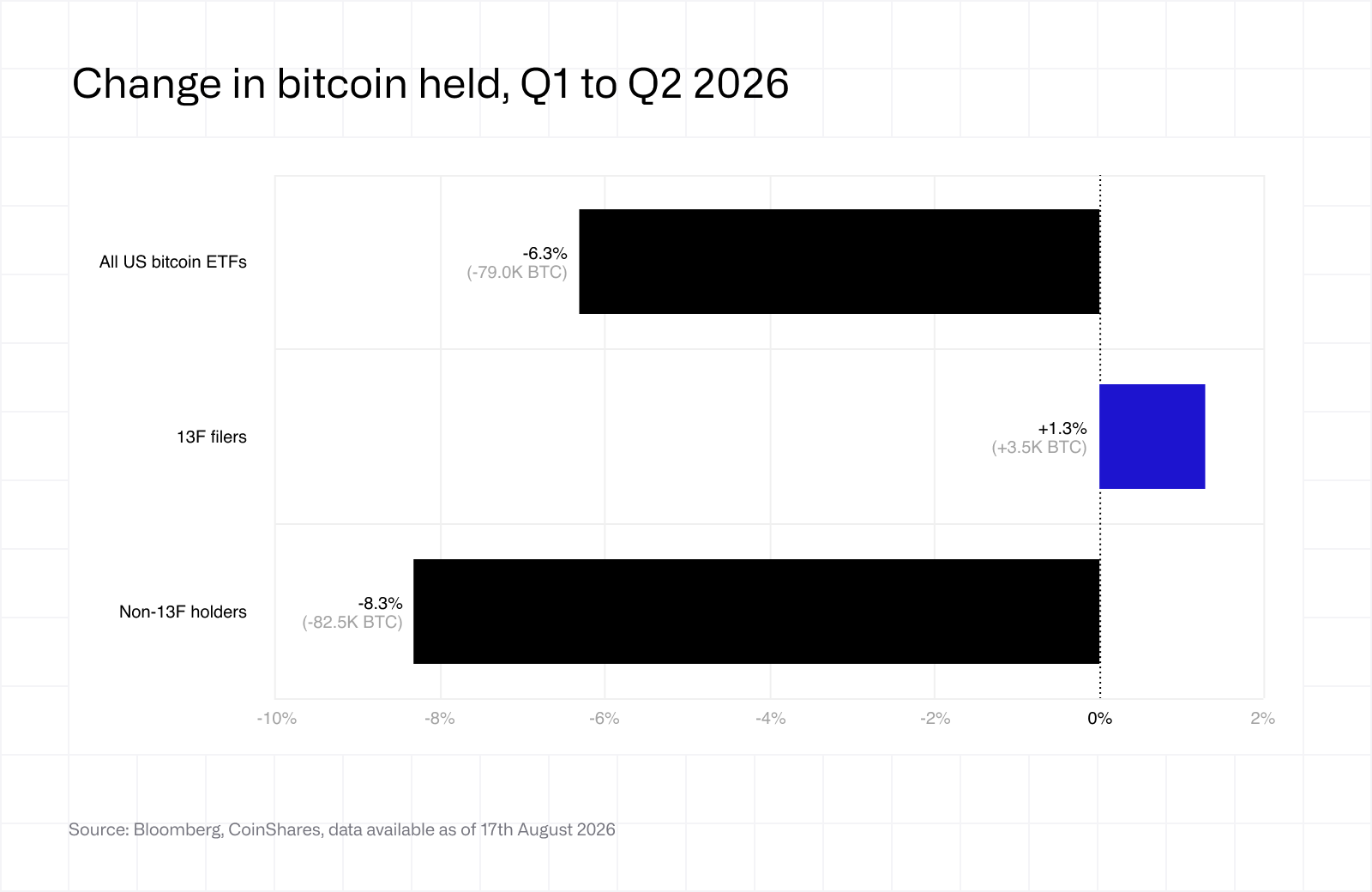
Who sold, who bought
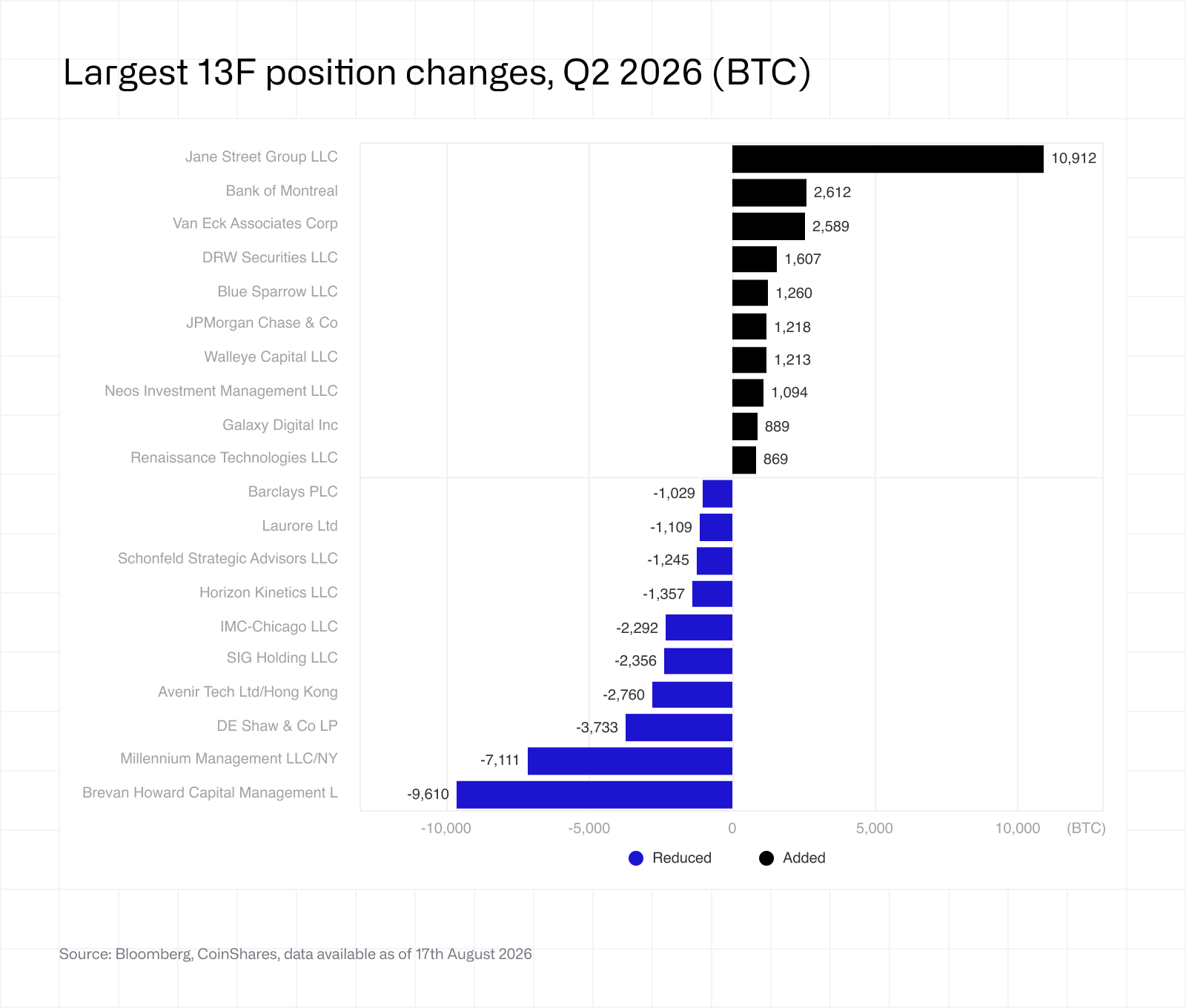
Hedge funds again accounted for the largest reduction, cutting exposure by 10.8k BTC (-22% QoQ) to 37.8k BTC, less than half their year-end level of 80.1k. DE Shaw exited its 3.7k BTC position and Millennium reduced its holding from 14.4k to 7.3k BTC.
Advisors reduced by 4.6k BTC (-3.0% QoQ) to 145.7k BTC, roughly 55% of all 13F bitcoin holdings. Brevan Howard cut its position by 9.6k BTC, from 13.7k to 4.1k.
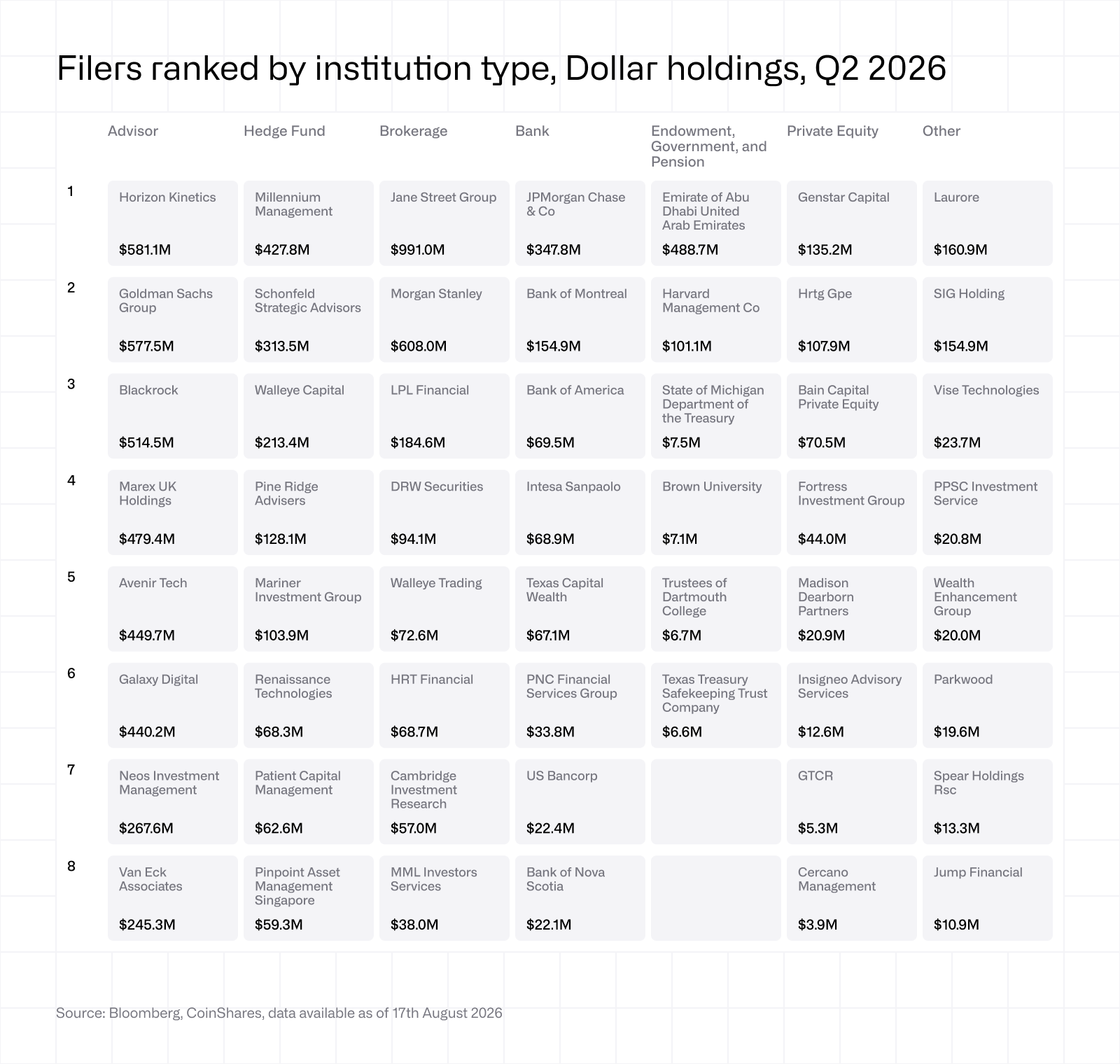
Brokerages rose to 38.5k BTC from 17.0k. Jane Street, an ETF market maker, added 10.9k BTC to 16.9k. The total also includes Morgan Stanley's 10.4k BTC; its Q1 13F, filed on 15 May, was not in the Bloomberg data used for the Q1 report.
Governments and endowments were broadly unchanged: the Emirate of Abu Dhabi held 8.4k BTC, Harvard 1.7k, Brown 121 and Dartmouth 114. Private equity rose 5% to 6.9k BTC.
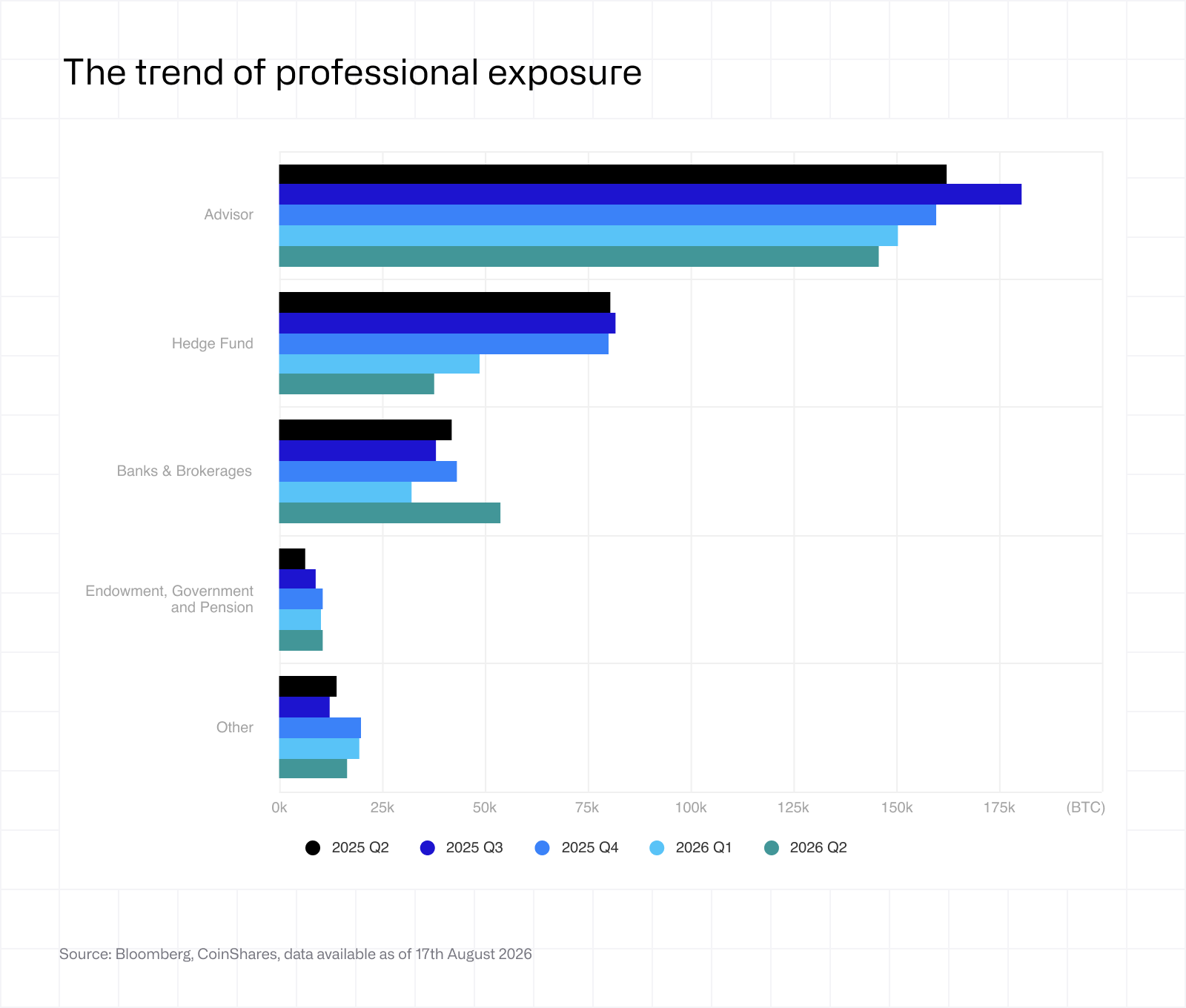
The pattern we described in Q1 continued. Leveraged and tactical positioning kept unwinding, with hedge funds reducing exposure for a second consecutive quarter. Advisors, banks, sovereigns and endowments - the more strategic, longer-duration holders held broadly steady. With non-filing holders selling harder, that part of the base now accounts for a larger share of ETF ownership.
Looking ahead
The SEC issued a press release titled "SEC Proposes New Regulation Crypto Assets." The proposed rules would give crypto projects two lighter-touch ways to raise money from investors without a full securities registration, and would include a route for a token to stop being treated as a security once the team's promised work is done. There is a 60-day comment window, which will be a first read on how the industry and any dissenting commissioners respond. If adopted, it would mark one of the clearest paths yet for crypto issuers to raise capital onshore, rather than defaulting to offshore structures.
On the other hand, the Middle Eastern conflict has persisted, with no sign of resolution; oil has pushed back above $100/bbl, and consumer inflation expectations have risen well above the Federal Reserve's 2% target, culminating in September's rate hike, the first since 2023. Yet the market's response over the past couple of months has been notably constructive: bitcoin rallied roughly 25% in August, its strongest month in nearly two years, and ETF flows swung from July's near-stagnation to $3.5B of net inflows in August, cutting the year's cumulative outflow by two-thirds. That resilience in the face of a genuinely hostile macro backdrop is arguably a more interesting story than the backdrop itself, and is positively reinforcing the bitcoin thesis for institutional investors weighing whether the asset can hold its ground independent of rate policy.
Q3 filings will show the landscape post-yearly lows and the new allocation for these institutional investors, the clearest test yet of whether professional demand holds up once the dust from Q2 settles.
Published onOct 9th, 2026
