


What is Ethereum? A complete guide to ETH and smart contracts
 25 min read
Bitcoin proved that money could work without a bank. Ethereum asked a broader question: what else could work that way? A decade on, it is the settlement layer for most of the value that moves on public blockchains.
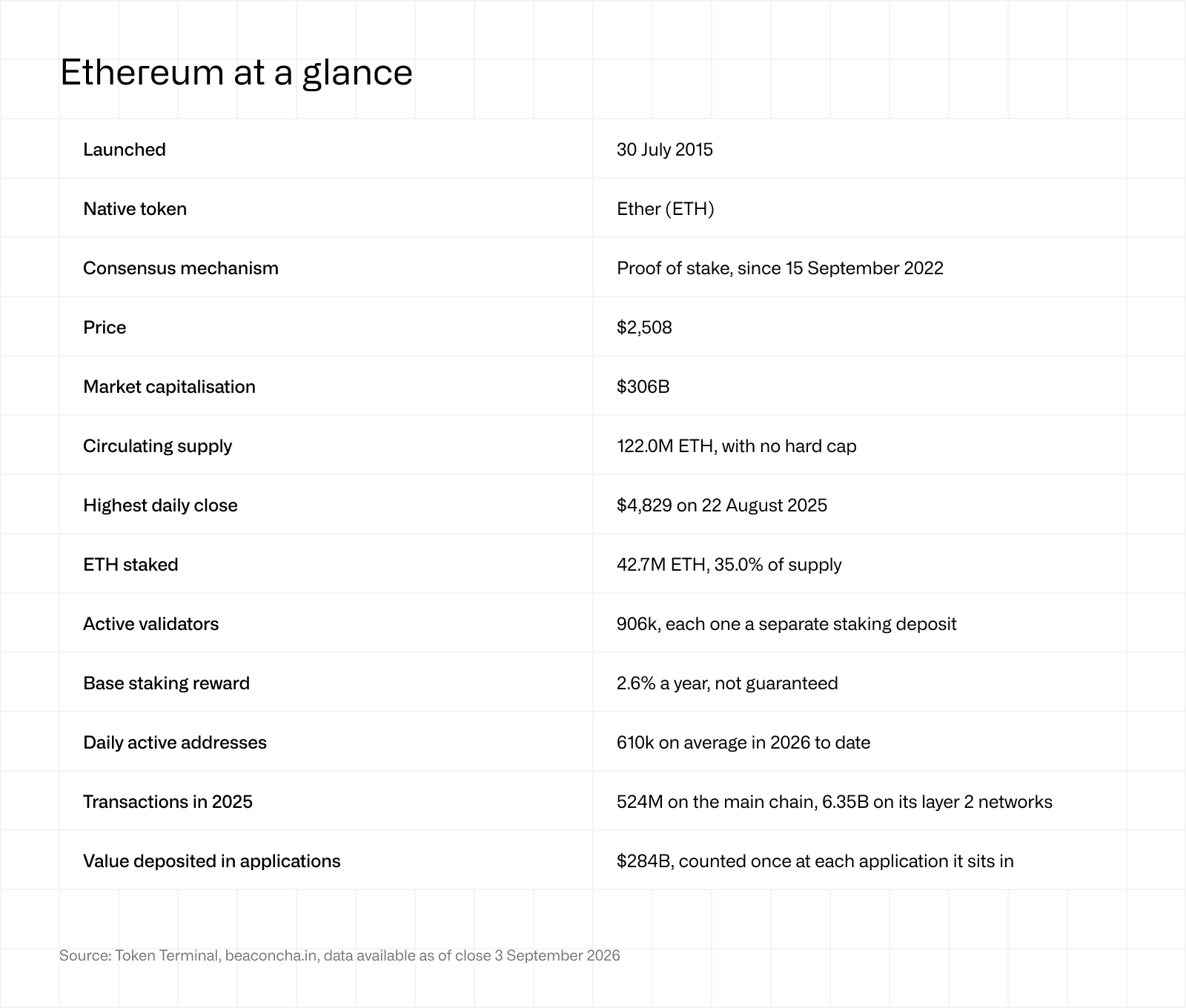
Ethereum is a blockchain, a shared database that thousands of independent computers keep in sync without any single company in charge. It launched in July 2015, and its native token is called ether (ticker: ETH).
Where Bitcoin does one job extremely well, moving and storing value, Ethereum was built to run software. Anyone anywhere can publish a program to Ethereum and it will run exactly as written, for as long as the network exists, with no company able to change it or switch it off. Those programs are called smart contracts, and they are what separates Ethereum from every blockchain that came before it.
If Bitcoin is often called digital gold, Ethereum is closer to digital oil: not the store of value itself, but the fuel that a wider financial system runs on. As of 3 September 2026, ETH trades at $2,508 with a market capitalisation of $306B, which makes it the second largest digital asset after Bitcoin, at a little under a fifth of Bitcoin's size.1
Key takeaways
Ethereum is the leading smart contract platform. It accounts for 58.7% of the combined market value of the twelve largest smart contract blockchains, and for just over three fifths of all the money deposited in decentralised finance applications, the lending, borrowing and trading services that operate without a bank in the middle.1
Ethereum switched in September 2022 from proof of work, where computers compete by burning electricity, to proof of stake, where participants put up their own ETH as a security deposit instead. Bitcoin still uses proof of work. This is the single most important technical difference between the two.
42.7M ETH, 35.0% of all ether in existence, is staked: locked up as that security deposit in exchange for a reward currently running at 2.6% a year. Staking rewards are not guaranteed and vary.2
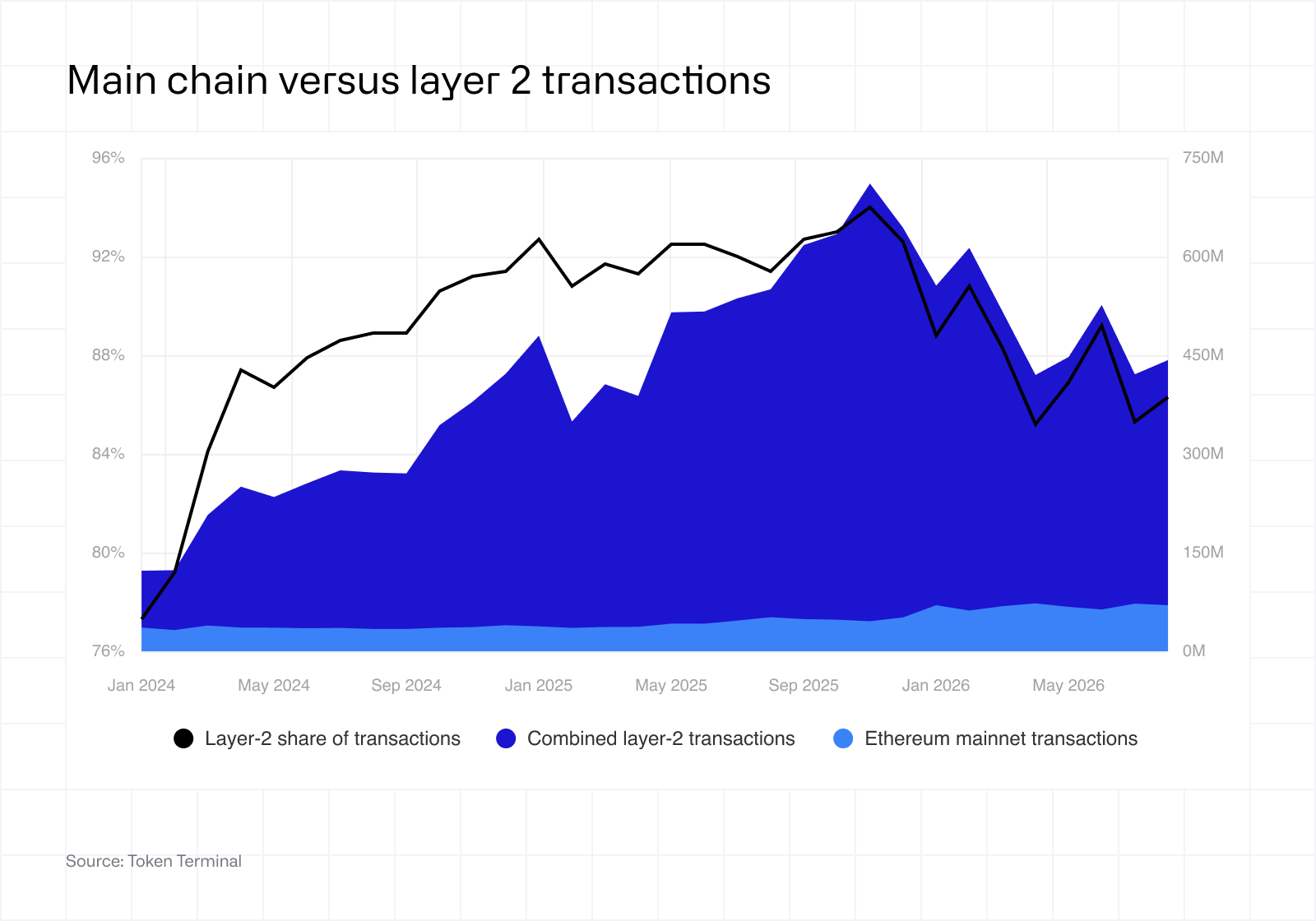
Most Ethereum activity has moved off the main chain and onto layer 2 networks, separate and far cheaper networks that bundle transactions together and post a summary back to Ethereum. In 2026 to date they have carried close to nine in ten of all transactions in the Ethereum ecosystem.1
You can get regulated exposure to ETH, with staking rewards included, through the CoinShares Ethereum Staking ETP (ETHE), an exchange traded product bought through an ordinary brokerage account, which charges 0.00% management fees.3
How Ethereum works
Proof of stake
Every blockchain needs a way for strangers to agree on which transactions are real without trusting each other. That method is called a consensus mechanism.
Bitcoin uses proof of work, where specialised computers burn electricity racing to solve a puzzle, and the winner adds the next batch of transactions. Ethereum used the same method until September 2022, then replaced it in an upgrade known as The Merge.
Ethereum now uses proof of stake. Instead of spending electricity, participants put their own ETH at risk as a deposit. The network picks one of them at random to propose the next batch of transactions, called a block, and the rest check the work. Behave honestly and you are paid. Behave dishonestly and the network destroys part of your deposit, a penalty called slashing.
The energy saving was dramatic. The Crypto Carbon Ratings Institute measured Ethereum's electricity use falling by more than 99.98% overnight, from roughly 23M megawatt hours a year to a little over 2,600. A megawatt hour is roughly what a European household uses in a month, so Ethereum went from consuming as much power as a mid-sized country to consuming about as much as a small town.4
Validators and the 32 ETH deposit
A validator is a single unit of staked deposit doing that checking work. Running one on your own requires 32 ETH, worth roughly $80k at today's price, plus a computer that stays online.
There are currently 906k active validators.2 That number is not the same as the number of people staking, and it fell sharply during 2026 rather than rising. The reason is a 2025 upgrade called Pectra, which let a single validator hold up to 2,048 ETH instead of being capped at 32. Large stakers merged hundreds of small validators into a few big ones, so the headline validator count went down while the amount of ETH staked went up. Validator count is no longer a good measure of how many participants secure Ethereum.
Staking and rewards
Staking is the act of locking ETH up to help secure the network in exchange for a reward. You do not have to run a validator yourself. Most people stake through an exchange, a staking service, or a regulated investment product that does it on their behalf.
As of early September 2026, 42.7M ETH is staked, 35.0% of all ether in existence and worth $107B. The base reward is running at 2.6% a year.2
That rate is not fixed. It falls as more ETH is staked, because the same pool of rewards is shared among more participants, and it rises with network activity, because validators also collect a share of transaction fees. Demand to stake is currently high enough that new deposits wait in a queue: 2.1M ETH is queued to start staking, with a wait of 36 days.2 Staking rewards are not guaranteed and may vary.
Gas and fees
Every action on Ethereum costs a fee, paid in ETH and known as gas. Gas measures how much computing work an action requires: a simple transfer costs little, a complex trade costs more. Fees are usually quoted in gwei, which is one billionth of one ETH.
Two things happen to a gas fee. A portion called the base fee is destroyed, or burned, and permanently removed from supply. The rest goes to the validator as a tip. This split was introduced in August 2021 by a protocol change known as EIP-1559.
Fees have collapsed as activity has moved to layer 2 networks. The average fee to use the Ethereum main chain has fallen by four fifths in a year, from $1.00 a transaction across calendar 2025 to $0.20 in 2026 to date. In cash terms, users paid $526M in main chain fees across the whole of 2025 and $113M in 2026 to date.1
Does the supply shrink?
Ethereum has no hard cap on supply, unlike Bitcoin's 21M limit. New ETH is created continuously to pay validators, and burned continuously through the base fee.
Since the fee burn began in August 2021, 4.6M ETH has been destroyed. But more has been issued than burned over the same period, so circulating supply has still grown, from 117.0M to 122.0M.1
What changed at The Merge was the rate. In the thirteen months before it, supply grew at 2.7% a year even after the burn, because miners were being paid too. In the four years since, it has grown at 0.3% a year. Ethereum is not reliably deflationary, and describing it that way is wrong. It is close to flat, which is a different and more defensible claim.
What smart contracts are and what they enable
A smart contract is a program stored on the blockchain that runs automatically when its conditions are met. The standard analogy is a vending machine: put in the right coins, press the right button, and the machine hands over the item. Nobody has to approve it, and nobody can decide not to.
Smart contracts run on simple if-then logic. If this payment arrives, then release those tokens. Once published, the code is visible to everyone and cannot be quietly altered. That is the appeal, and it is also the risk: a bug in a smart contract is permanent, and a mistake can be exploited by anyone who notices it.
Four things built on that idea are worth knowing about. The first is decentralised finance, usually shortened to DeFi: lending, borrowing and trading without a bank in the middle. $284B of value sits in applications on Ethereum, just over three fifths of the total across all blockchains. That total is a sum of what each application holds and it is not adjusted for double counting: a deposit in one application that is then pledged as collateral in a second is counted in both, so the figure is larger than the amount of money actually deposited.1
The second is stablecoins, tokens designed to hold a steady value, usually one US dollar, and backed by reserves. $163B of stablecoins are issued on Ethereum, more than on every other blockchain combined.1
The third is tokenisation: money market funds, bonds and private credit issued as tokens on a blockchain rather than as entries in a registrar's ledger, so they can settle in minutes rather than days. The fourth is ownership records of other kinds, from NFTs, which are tokens that are individually unique rather than interchangeable and are used for digital art and collectibles, to DAOs, which are organisations whose decisions are taken by token-holder vote and executed automatically by contract.
Ethereum vs Bitcoin: what is the difference?
Bitcoin and Ethereum are complementary rather than competing. Bitcoin is a fixed-supply monetary asset. Ethereum is a platform for building things.
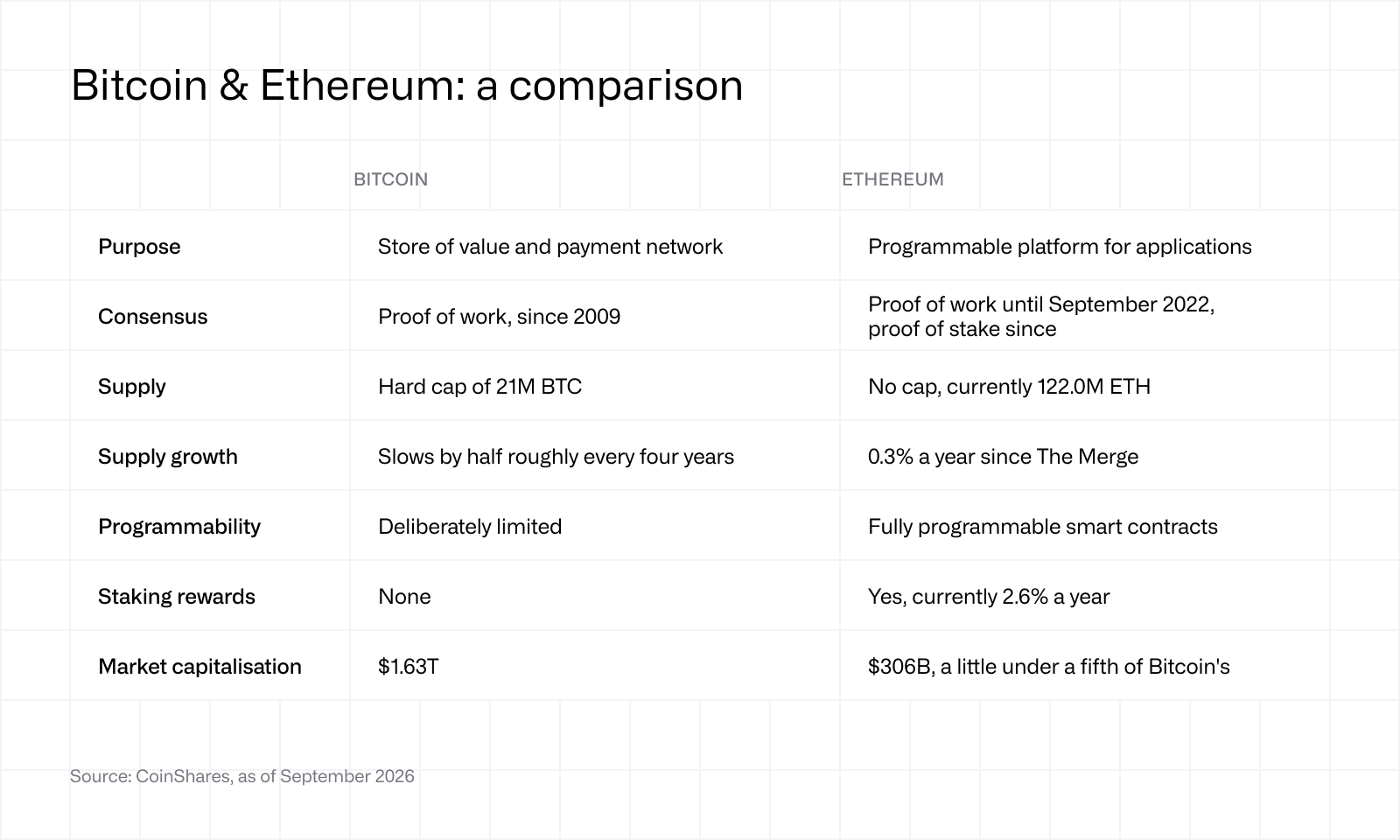
The consensus row is the one most often got wrong, including in earlier versions of this guide. To be unambiguous: Bitcoin uses proof of work. Ethereum used proof of work until 15 September 2022 and has used proof of stake ever since. They do not both use proof of stake.
The practical consequence is that ETH can generate a reward simply by being held and staked, while BTC cannot. That makes ETH the closest thing in digital assets to a yield-bearing asset, with the important caveat that the reward is paid in ETH and is worth whatever ETH is worth.
Layer 2s: where Ethereum activity actually happens
A layer 2 is a separate network that processes transactions cheaply and quickly, then periodically posts a compressed record of what it did back to Ethereum. Ethereum remains the referee and the final record. The layer 2 handles the traffic.
The analogy that works is a card payment network. Individual purchases clear in a fast side system all day, and the net position settles with the banks at the end. Ethereum is the settlement layer. The layer 2s are where the purchases happen.
The shift has been decisive. In calendar 2025 the ten largest layer 2s processed 6.35B transactions between them, against 524M on the Ethereum main chain, so 92.4% of all activity in the Ethereum ecosystem happened somewhere other than Ethereum itself. Through the first eight months of 2026 that share has eased to 87.8% as main chain volumes recovered, which still leaves close to nine transactions in ten on a layer 2.1
The largest by some distance is Base, launched by Coinbase, which alone handled around 3.7B transactions in 2025, more than half the layer 2 total. Arbitrum, OP Mainnet, Starknet, World Chain, Unichain, zkSync, Linea and Scroll make up most of the rest.1
Fees are the reason. A transaction that costs cents on the main chain typically costs a fraction of a cent on a layer 2. This was made possible by an upgrade called Dencun in March 2024, which created a cheap temporary data lane, known as blobs, specifically for layer 2s to post their records into.
There is a trade-off worth understanding. Layer 2s inherit Ethereum's security for the record of who owns what, but most still rely on a single operator to decide the order in which transactions are processed, and several retain the ability to change their own code. They still ask the user to trust an operator in a way the main chain does not.
History and milestones
In 2013, a nineteen-year-old programmer named Vitalik Buterin published a paper arguing that Bitcoin's design was too narrow, and that the same idea could support a general-purpose computer rather than only a currency. Development began the following year and the network went live in 2015.
2015. Ethereum launches, following a public token sale and the creation of the Ethereum Foundation.
2016. An attacker drains a large smart contract called The DAO. The community votes to reverse it, splitting the chain in two. The reversed chain is the Ethereum we use today; the other continues as Ethereum Classic.
2017. The Enterprise Ethereum Alliance launches with members including Accenture, Intel, JP Morgan and Microsoft.
2020. The Beacon Chain goes live in December, running proof of stake in parallel while the main chain still uses proof of work.
2021. EIP-1559 introduces the fee burn in August. ETH sets what was then a record high in November.
2022. The Merge, on 15 September. Ethereum abandons proof of work and switches fully to proof of stake, cutting energy use by more than 99.98%.4
2024. Dencun, in March, introduces blobs and cuts layer 2 costs by an order of magnitude. Spot Ethereum exchange traded products begin trading in the US in July.
2025. ETH sets a record daily close of $4,829 on 22 August.1
2026. Staked ETH passes 35.0% of supply for the first time. On 17 March, the SEC and the CFTC publish a joint interpretive release setting out when staking falls outside US securities law
What is next on the roadmap
The next scheduled upgrade is Glamsterdam, expected to reach the main chain in late 2026 after rehearsals on test networks from late September. Its headline changes are technical rather than user-facing: a redesign of how blocks are built and proposed, and a substantial increase in the network's capacity target.5
Beyond that, in July 2026 Vitalik Buterin published a plan he calls Lean Ethereum, a three to four year programme covering most of the protocol. It aims to move far more capacity back onto the main chain, with a long-term target of thousands of transactions per second directly on Ethereum rather than only on its layer 2s. It aims to cut the time before a transaction becomes irreversible to somewhere between ten and twenty seconds. It would replace cryptography that a future quantum computer could break. And it would build in privacy, so that transacting on Ethereum no longer means publishing your entire financial history.
These are goals, not commitments. Ethereum has a long record of shipping upgrades late, and several senior developers have publicly argued the timeline is too slow. Treat the roadmap as direction rather than schedule.
How to get exposure to Ethereum
There are three practical routes.
Buy ETH directly on an exchange. You own the asset and can stake it yourself, but you are responsible for keeping it safe, for protecting the private keys that control it and cannot be reset if they are lost, and for the tax reporting.
Buy an exchange traded product. An ETP is a security listed on a stock exchange that tracks the price of an asset. You buy it through an ordinary brokerage or bank account, alongside your shares and funds, and there are no wallets or keys to manage. A physically backed ETP holds real ETH with a regulated custodian, the specialist firm that safeguards the asset on investors' behalf, rather than tracking the price through derivatives.
Buy a staking ETP. Some ETPs stake the ETH they hold and pass the reward on to investors. This is the only route that gives a conventional investor the staking reward without operating anything.
The CoinShares Ethereum Staking ETP (ticker ETHE, ISIN GB00BLD4ZM24) is 100% physically backed by ETH held with an institutional custodian, charges 0.00% management fees, and pays a staking reward of 1.25% a year, which is not guaranteed and may vary. It launched in February 2021 and held $403M in assets as at 28 August 2026. It is listed on Xetra in Germany, Euronext Paris and Amsterdam, SIX in Switzerland, the London Stock Exchange and Borsa Italiana, so most European investors can buy it through a broker they already use.3
The reserves backing every CoinShares ETP are published and independently verified, so holders can check at any time that the product holds the ETH it says it holds.3
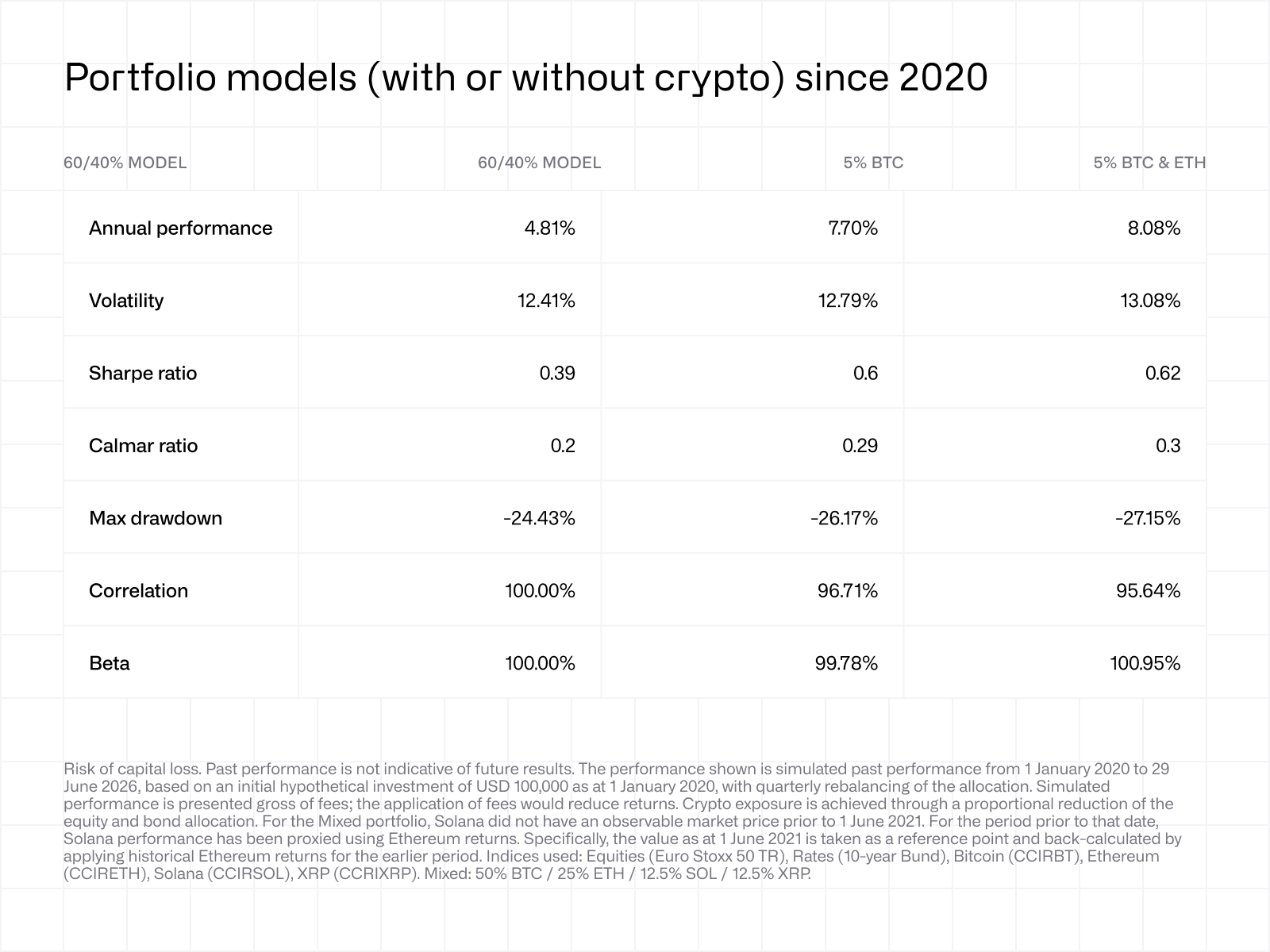
On sizing, CoinShares' portfolio allocation model looks at what a small digital asset sleeve does to a traditional portfolio. These are simulated results, not an actual track record. In the simulation, a 5% allocation split between bitcoin and ether would have lifted annualised performance from 4.8% to 8.7% and the Sharpe ratio, a measure of return per unit of risk, from 0.39 to 0.70, while the worst peak-to-trough loss widened from 24.1% to 26.6%. The point is not that the allocation is free. It is that at 5%, the extra return has historically been larger than the extra drawdown.
Investors' capital is at risk and they may lose part or all of their investment. Crypto ETPs are complex products and may be difficult to understand. Past performance is not a reliable indicator of future returns. Staking rewards are not guaranteed and may vary. Refer to the prospectus and the relevant key information documents before investing.
CoinShares' analysis
Strengths
Ethereum's incumbency has stopped eroding. It held 78.7% of the combined market value of the twelve largest smart contract blockchains at the end of 2020 and fell to 55.9% by the end of 2024. Since then the slide has stopped: the share stands at 58.7% today.1 The long decline that dominated commentary for years has flattened out.
More to the point, Ethereum is where the money is. Just over three fifths of all the value deposited in decentralised finance across every blockchain sits on Ethereum, and more stablecoins are issued on Ethereum than on all other blockchains combined.1 Share of price is one thing; share of the assets people actually leave in place is a stickier thing. Behind that sits the largest developer base in the industry, which added more new developers in 2025 than any other blockchain.7
And staking gives ETH a native income stream that Bitcoin has no equivalent to. It is paid in ETH rather than in cash, and it is not guaranteed, but it is a real economic difference between the two largest digital assets.
Opportunities
The clearest near-term opening is regulated staking products. The SEC and CFTC joint interpretive release of 17 March 2026 holds that staking sits outside US securities law where the provider acts as the customer's agent, exercises no discretion over the staked assets and does not guarantee the reward.6 That removed the principal securities-law obstacle to staking inside US exchange traded products, in the world's largest market. It is a narrower change than the commentary around it suggested: it turns on how a product is structured rather than settling the status of staking in general. European staking ETPs have existed for years and the US is only now catching up, and flows tend to follow the products.
The slower and larger opening is tokenisation. Money market funds, treasuries and private credit are increasingly issued on a blockchain rather than in a registrar's ledger, and Ethereum is the default venue for the institutions doing it. It is a long adoption curve, but it is the one that most plausibly turns Ethereum into infrastructure that ordinary finance depends on. It is also why the capacity work matters: Dencun and Fusaka both delivered material cost reductions rather than being deferred again, and Glamsterdam targets a substantial capacity increase on the main chain itself.
Weaknesses
The hardest question about the investment case is that the success of layer 2s has cannibalised the main chain. Close to nine in ten transactions now happen on networks that pay Ethereum very little for the privilege. Main chain fee income fell from $526M in 2025 to $113M in the first eight months of 2026, and the amount burned fell further still.1 Scaling worked, and it moved the revenue somewhere else. Whether Ethereum can charge for settlement at anything like the rate it once charged for congestion is unresolved, and anyone buying ETH is taking a view on it.
That feeds a second problem: the deflation story does not hold. Supply has grown, not shrunk, since the burn began, and it grows faster as the burn falls.1 Any pitch resting on ETH becoming scarcer over time is contradicted by the data.
Two further weaknesses are structural rather than economic. Code that cannot be changed is code that cannot be patched, so smart contract risk is permanent: exploits of applications built on Ethereum have cost users billions of dollars, and the network itself will not reverse them. And dozens of layer 2s, each with its own fees, its own token and its own way of moving money in and out, make for a genuinely confusing experience for a newcomer in a way that Bitcoin is not.
Threats
Concentration in staking is the one to watch. A third of all ETH is staked, and a large share of that runs through a handful of large operators and through services that issue a tradable receipt for staked ETH. That is a governance and censorship concern rather than a theft risk, but it is a real one.
There is also competition on price: Solana, BNB Chain and others are faster and cheaper on their own main chains, and have taken meaningful share of retail activity. There is regulatory classification, argued over for a decade and settled in some jurisdictions and not others. The March 2026 US interpretive release helps, but it applies only to staking arrangements that meet its conditions, it does not address the status of ETH itself, and it does not close the question outside the US. And there is corporate treasury concentration: several listed companies now hold ETH positions running to millions of coins, funded by issuing equity. That has been a source of demand, and it can become a source of forced supply if their financing conditions turn.
What it comes down to
Ethereum is neither a cheap nor a simple thing to own, and the layer 2 question is the reason a careful investor would hesitate. But the difficulty and the case are the same fact. Ethereum made itself cheap enough to use, and what is being built on it now looks less like speculation and more like plumbing: stablecoins that move more dollars than every other blockchain combined, and funds and bonds that settle in minutes rather than days. If the digital oil analogy holds, the price of the fuel matters less over time than how much machinery ends up running on it. That is the thing to watch, and it sets the sizing question rather than answering it: whatever number an investor lands on should be small enough that being wrong about it is survivable, which is the whole logic of the 5% sleeve in the model above.
Frequently asked questions
What is Ethereum in simple terms?
Ethereum is a public computer that nobody owns. It is a blockchain, a shared record kept in sync by thousands of independent machines, which can run programs as well as move money. Its token is called ether (ETH). Anyone can publish a program to it, and once published, that program runs as written and cannot be shut down by any single party.
Is Ethereum a good investment?
That depends entirely on your circumstances and risk tolerance, and nothing here is advice. What can be said factually is that ETH is highly volatile, has no cap on its supply, currently pays a staking reward of 2.6% a year, and trades 48.1% below its record daily close of August 2025. Capital is at risk.
How much can you earn staking Ethereum?
The base network reward is currently 2.6% a year, paid in ETH.2 The rate falls as more ETH is staked and rises with network activity, so it changes constantly. Products that stake on your behalf pass on a portion after costs: the CoinShares Ethereum Staking ETP pays 1.25% a year with 0.00% management fees.3 Staking rewards are not guaranteed and may vary.
Why is Ethereum so much cheaper to use than it used to be?
Two upgrades, Dencun in March 2024 and Fusaka in December 2025, created and then expanded a cheap data lane for layer 2 networks. Layer 2s now handle close to nine in ten Ethereum transactions at a fraction of a cent each, and less congestion on the main chain has pulled main chain fees down too, from $1.00 a transaction on average in 2025 to $0.20 in 2026 to date.1
Does Ethereum have a maximum supply?
No. Bitcoin is capped at 21M coins; Ethereum has no equivalent limit. New ETH is issued continuously to pay validators, and a portion of every fee is destroyed. Since the fee burn began in 2021 the burn has not kept up with issuance, so supply has grown, though at 0.3% a year since 2022 rather than the 2.7% before it.1
What is the difference between Ethereum and ether?
Ethereum is the network. Ether, or ETH, is the token used to pay for using it and to stake. In everyday usage people say "Ethereum" for both, and exchanges list the token under the ticker ETH.
Sources
Token Terminal, All data as at 3 September 2026..
Beaconcha.in, as of 4 September 2026.
CoinShares Ethereum Staking ETP (ETHE) product page and factsheet, key information as of 28 August 2026.
Crypto Carbon Ratings Institute (CCRI)
Ethereum Foundation
US Securities and Exchange Commission and Commodity Futures Trading Commission, joint interpretive release on staking activities, 17 March 2026.Electric Capital, Developer Report 2025.
Published onSept 14th, 2026