


What is Polygon - POL guide
 12 min read
Polygon is a network built to make transactions on Ethereum faster and cheaper. It launched in 2020 offering the same applications at lower fees, and for several years that was the extent of it.
Since 2024 Polygon has changed its token, POL (formerly MATIC) appointed its first chief executive, shut down its flagship zero-knowledge product and narrowed its focus to moving stablecoins. Network fees have tripled over that period
What Polygon is, and why the name changed
A sidechain close to Ethereum
Ethereum is a blockchain that can run programmes, not just record payments. It is also slow and expensive when busy, because every transaction competes for the same limited space.
A sidechain is a separate network that processes transactions away from Ethereum, then periodically reports the results back to it. Users get lower fees and faster confirmation. Polygon was one of the first secondary networks to reach real scale.
Polygon PoS, the network's main chain, works in four steps. A user makes a transaction in an application. That transaction is grouped into a block on Polygon. Validators, the computers that check and record transactions, confirm the block. Periodically, a summary of many blocks is written back to Ethereum as a checkpoint.
MATIC became POL
Polygon launched in 2017 as Matic Network and rebranded to Polygon in 2021, but the token kept the old MATIC ticker for years afterwards. In 2024 the network migrated to a new token, POL, which replaced MATIC one-for-one.
Nothing about a holder's economic position changed in the migration. What changed was the design intent: POL was built to secure several Polygon chains at once rather than one, which is the foundation the network's current architecture rests on.
What POL is used for
Transaction fees
Every transaction on Polygon costs a small fee paid in POL, typically a fraction of a cent, way below Ethereum's fee levels.
Staking and network security
Validators lock up POL as collateral, a process called staking, and are rewarded for confirming transactions honestly. Holders who do not want to run a validator can delegate their tokens to one and share the rewards. Staking is also the mechanism that ties POL's value to network security rather than to speculation alone.
Governance
POL holders vote on network decisions, including funding from the ecosystem treasury. In practice, direction has been set by Polygon Labs and the Polygon Foundation, and the 2025 leadership change made that more explicit rather than less.
Supply
Circulating supply stood at 10,67 billion POL on 30 June 2026.1 POL carries an annual issuance designed to fund validator rewards and ecosystem development, which means the token supply grows over time. That matters for anyone comparing POL's price history to its market value, because a falling price and a rising supply do not move together.
How Polygon performs today
Speed and cost
The Rio upgrade, activated in October 2025, rebuilt how Polygon produces blocks. It raised throughput to roughly 5,000 transactions per second and brought confirmation close to instant, while making it cheaper to run a node.2
Polygon's stated target is far higher. The Gigagas roadmap sets out a path to more than 100,000 transactions per second, framed explicitly around payments rather than general computing.3 Polygon has not demonstrated anything close to that figure in production, and the roadmap should be read as an ambition.
Fees and usage
Network fees measure whether anyone is willing to pay to use a blockchain. On Polygon they have tripled.
Polygon collected $19,83M in fees over the first half of 2026, more than three times the $5,91M it collected across the whole of 2025. Protocol revenue, the share of those fees the network retains, rose from $2,11M to $11,12M over the same comparison.1 Average daily transactions roughly doubled year on year, and fee income grew faster still.1
The user base did not grow with it. Polygon averaged 649,000 daily active addresses in 2025 and 601,000 over the first half of 2026, so the additional fee income came from more activity per address rather than from more addresses.1
How Polygon compares to Ethereum or Solana
Against Ethereum, Polygon trades security assurances for cost. Ethereum is the settlement layer with the deepest liquidity and the strongest guarantees; Polygon is where transactions happen when those guarantees cost more than they are worth.
Against Solana, the difference is scope. Solana runs a broad consumer and trading ecosystem at high speed. Polygon has deliberately narrowed to payments and tokenised assets.
Against Layer 2 networks such as Arbitrum and Optimism, Polygon's distinguishing feature is enterprise and payments distribution rather than DeFi depth, and its own consensus.
Market performance
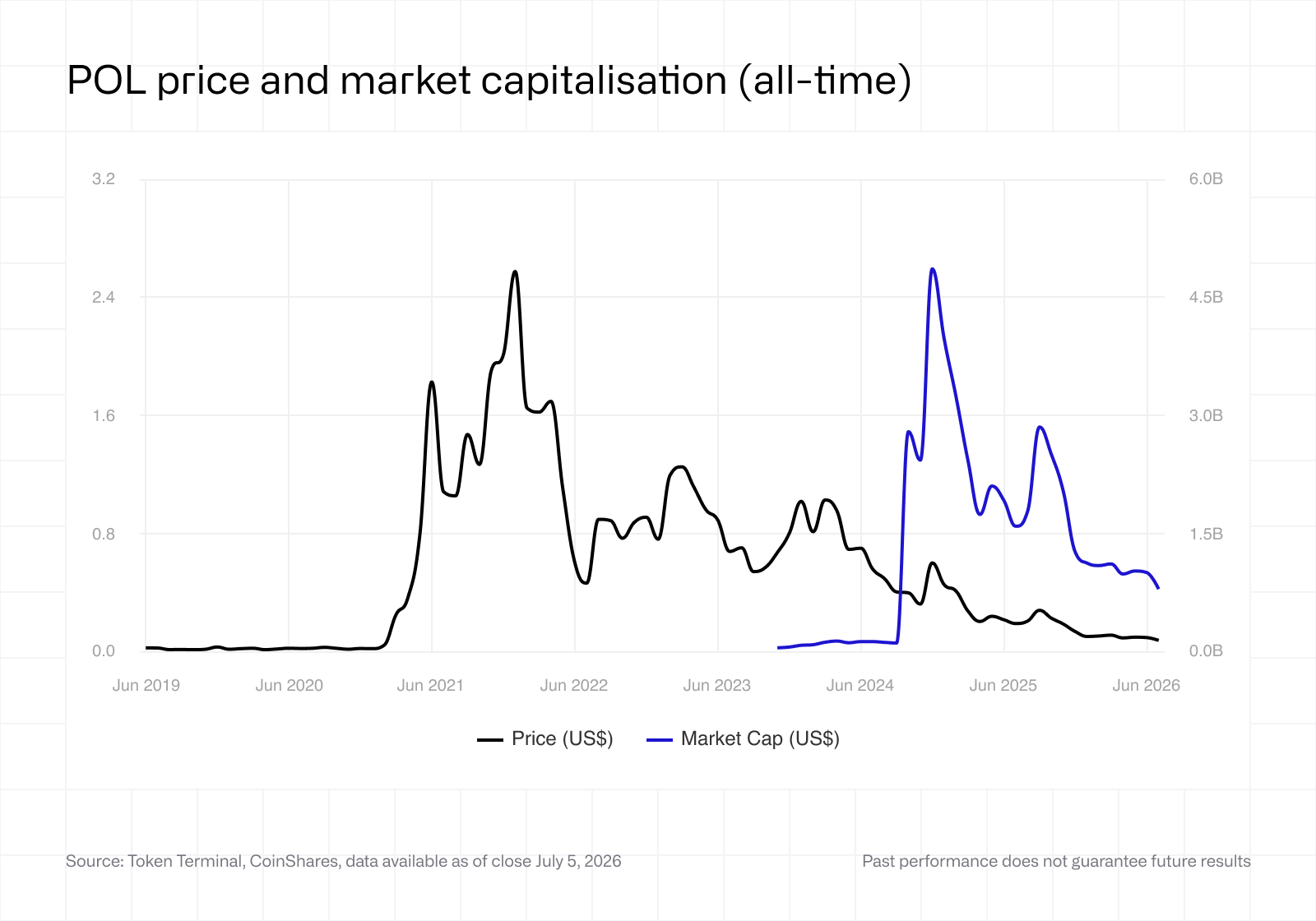
POL traded at $0,0707 on 30 June 2026, giving a circulating market capitalisation of $729,7M.1 Its highest price on record was $2,88, reached on 26 December 2021.1 Past performance is not a guide to future returns.
The network earned more since January 2026 than in the preceding year, while the token lost nearly a third of its value. One explanation is that the market has not yet priced the payments business. Another is that it has priced it, and concluded that very little of the payment volume reaches POL holders. Half-year fees of $19,83M against a market capitalisation of $729,7M lend some weight to the second.
The ecosystem
Stablecoins and payments
Payments are now the centre of the network. Stablecoin supply on Polygon was $1,25B on 30 June 2026.1 Polygon reports that stablecoin transactions grew 264% year on year through 2025 and that the network processed more than 577 million stablecoin transactions in April 2026 alone.
In January 2026, Polygon Labs announced the Open Money Stack, a set of tools aimed at fintechs, enterprises and payment applications building on stablecoins and tokenised deposits. It is the clearest statement yet of what Polygon sells.
Tokenised real-world assets
Tokenised real-world assets are traditional instruments, such as money market funds or bonds, issued as tokens on a blockchain. Polygon has pursued this alongside payments, on the logic that both need cheap, fast settlement rather than complex programmability.
Decentralised finance
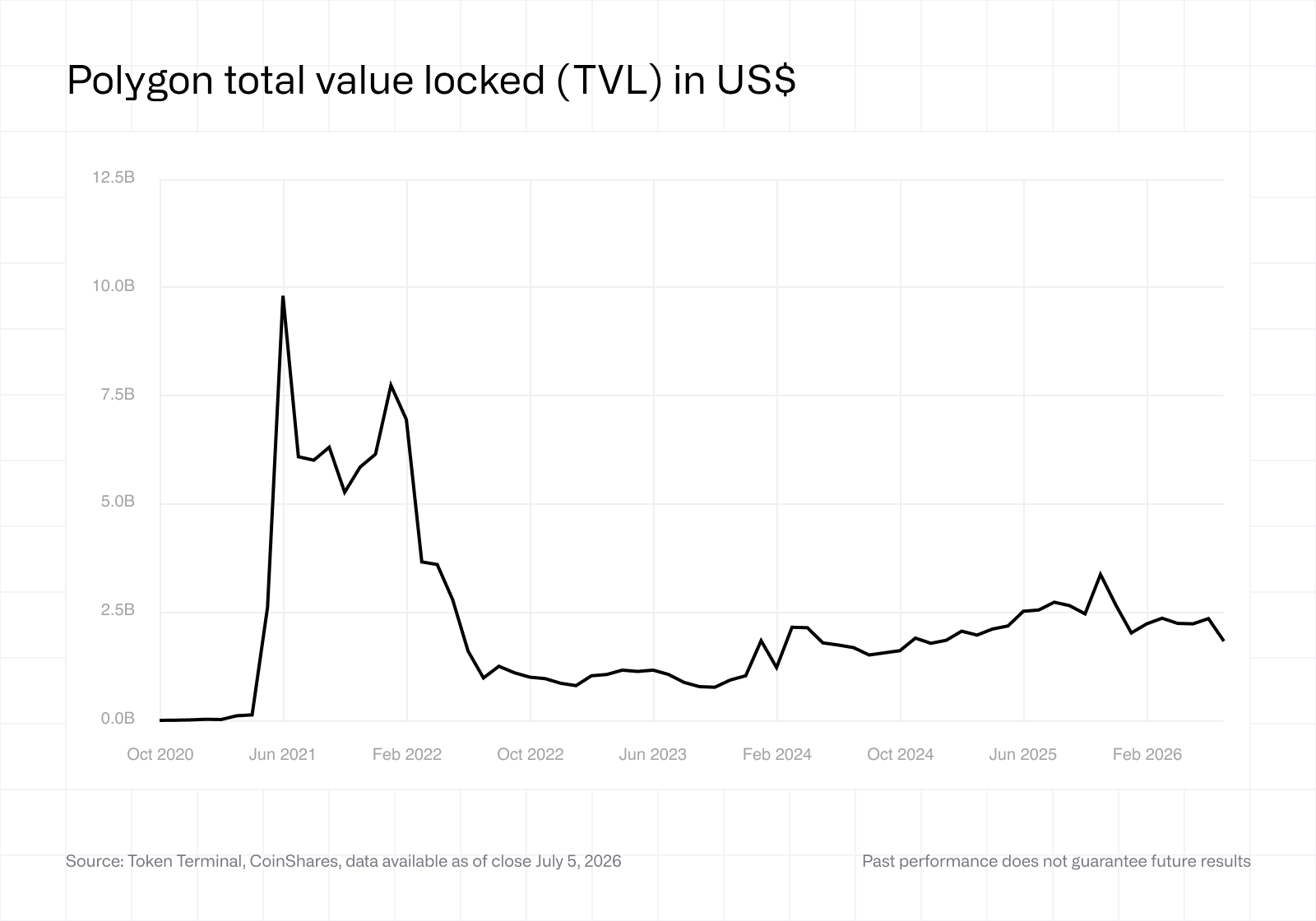
Total value locked, meaning the value of assets deposited in applications on a network, stood at $1,88B on 30 June 2026.1 That is well below Polygon's 2021 peak but has been broadly stable through 2025 and 2026, which is more than several competing networks managed over the same period.
What was retired
Polygon zkEVM, a zero-knowledge scaling network launched in 2023 and once presented as the network's future, is being shut down. Its sequencer, the component that orders transactions, was scheduled to stop in July 2026. Polygon PoS is unaffected, as are independent chains built with Polygon's Chain Development Kit.
Few networks retire a flagship product. zkEVM absorbed several years of engineering work, and writing it off is the sharpest available evidence of how far the strategy moved under new leadership.
Strengths and limitations
Strengths
Polygon has a real and growing payments business, evidenced by fee income rather than announcements. It has an unusually clear strategy for a network of its age. Fees are low enough for small payments to work, and the Rio upgrade made confirmation fast enough for point-of-sale use. Enterprise and fintech distribution is a genuine advantage over Layer 2 networks that compete only on DeFi.
Limitations
The token has not captured the network's improvement, and that is the central risk for anyone holding POL rather than using Polygon. Ongoing issuance adds supply regardless of demand.
Polygon mostly depends on Ethereum, so changes to Ethereum's own costs and capacity directly affect the case for using a secondary network at all. Competition in stablecoin payments has intensified, with several networks now targeting the same customers, and some issuers launching chains of their own.
And Polygon has changed direction before. The current strategy is around eighteen months old, which is not long enough to judge it.
Conclusion
Polygon in 2026 is a narrower business than before. It processes payments, and in the first half of 2026 it earned more than three times what it earned in the whole of 2025 doing so. Whether any of that reaches POL holders is a separate question, and the token price suggests the market is doubtful.
Anyone weighing exposure is therefore choosing between two different propositions: the payments business, or the token. They have not moved together since 2024.
Frequently asked questions
Is Polygon the same as MATIC?
Yes. Polygon is the network; MATIC was the original name of its token. The token migrated to POL, which replaced MATIC one-for-one. Older articles and some exchanges still use the MATIC name, but POL is the current ticker.
Is Polygon a Layer 1 or a Layer 2?
Neither one or the other. Often confused as a Layer 2, Polygon PoS is an independent sidechain network: it processes transactions separately and periodically writes summaries back to Ethereum. It has its own validators, so it is more independent than some Layer 2 networks, but its security is anchored to Ethereum.
What is POL used for?
Four things : - paying transaction fees on Polygon- staking, to secure the network and earn rewards- voting on network governance decisions- funding ecosystem development through the treasury.
Why did Polygon shut down zkEVM?
Polygon zkEVM did not attract enough usage to justify continued development. Its sequencer was scheduled to stop in July 2026, and the network refocused on Polygon PoS for payments and on AggLayer for connecting chains. Polygon PoS and chains built with the Chain Development Kit are unaffected.
Is Polygon still used?
Yes, and more heavily than in 2025 by the measure that matters most. Polygon collected $19,83M in network fees in the first half of 2026 against $5,91M for all of 2025, with roughly 601,000 daily active addresses.1 Usage and token price have moved in opposite directions.
Sources
1 Token Terminal, Polygon network and market metrics, figures at 30 June 2026
2 Polygon, "Polygon launches major payments upgrade with Rio", October 2025
Published onJul 26th, 2023