


What is Sui - SUI guide
 11 min read
Sui is a Layer-1 blockchain — meaning it's a base-level network, like Ethereum or Solana, rather than something built on top of another chain. It was launched in May 2023 by Mysten Labs, a team largely composed of former Meta engineers who had previously worked on Diem, Meta's abandoned cryptocurrency project. That background left a clear imprint on Sui's design: it was built from scratch to handle the kind of scale that a platform serving billions of users would demand.
The goal was to solve a problem that has plagued most blockchains: as more people use them, they slow down and fees go up. Sui's answer was to rethink how transactions are structured and processed — which we'll get to in the next section. The result is a network that can handle a high volume of activity quickly and cheaply, making it particularly suited to applications like gaming, payments, and decentralised finance.
Sui's native token is SUI, used to pay transaction fees, participate in staking, and vote on governance decisions.
How Sui works
Object-centric model
Most blockchains keep track of balances the way a bank does: there's a central ledger, and when you send money, your account goes down and someone else's goes up. Sui does it differently. Everything on Sui — tokens, NFTs, smart contract data — exists as a distinct "object" with a clear owner. When you transact, you're directly moving that object, not updating a shared ledger.
Why does this matter? Because it means most transactions on Sui don't need to coordinate with each other. If you're sending SUI to a friend and someone else is trading an NFT, those two things are completely independent — they can happen at the same time without getting in each other's way. On a traditional blockchain, everything queues up sequentially. On Sui, a lot of it runs in parallel.
Parallel execution
On most blockchains, transactions queue up and get processed one by one, even when they have nothing to do with each other. It's like a motorway with a single lane: doesn't matter if you're driving a moped or a truck, everyone waits behind everyone else.
Because Sui treats everything as a distinct, individually owned object, it can tell at a glance when two transactions are completely unrelated. If you're sending SUI to a friend while someone else is buying an NFT, those two things don't interfere with each other, so Sui runs them at the same time. Multiple lanes open up automatically.
The result: most transactions on Sui settle in under a second, and fees stay low even when the network is busy, because congestion only affects transactions that are genuinely competing for the same resources.
Consensus and validators
To keep the network secure and agree on the final state of the ledger, Sui uses a delegated Proof-of-Stake system. Validators (the nodes responsible for processing and confirming transactions) are selected based on how much SUI has been delegated to them. Anyone holding SUI can delegate to a validator of their choice and earn a share of the rewards. You don't need to lock up your tokens or run any technical infrastructure yourself.
Sui's consensus protocol has been upgraded from its original Narwhal & Bullshark design to Mysticeti, which achieves near-instant finality even under high load.
Market performance
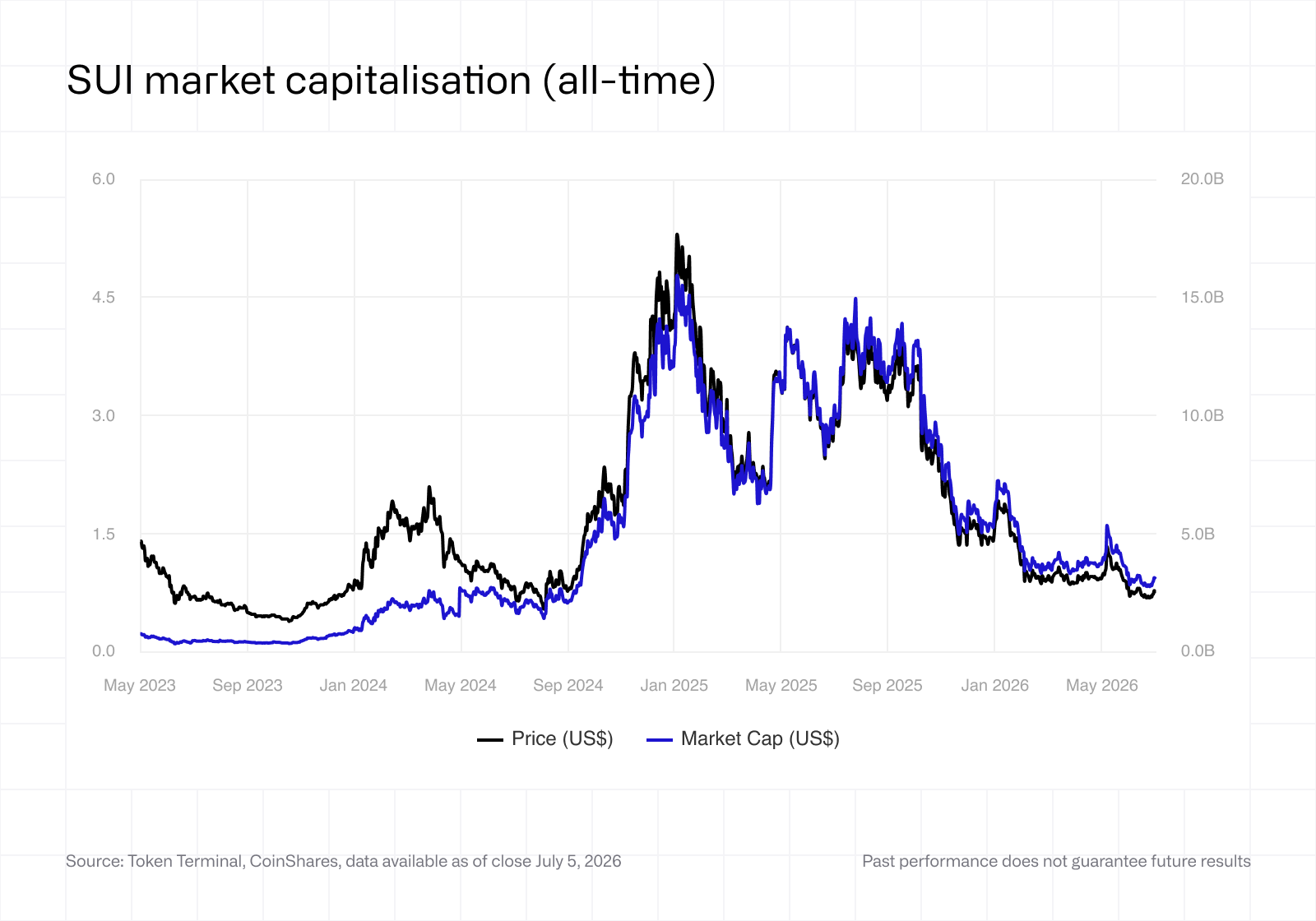
SUI traded at $0,689 on 30 June 2026, giving a circulating market capitalisation of $2,78 billion across 4,03 billion tokens in circulation. Past performance is not a guide to future returns.
The market capitalisation line on the chart tells a story the price line does not. Through 2023 and much of 2024 the two diverge sharply, because very little of the supply was in circulation at launch. Market capitalisation therefore kept rising for a period when the price was flat or falling, as scheduled unlocks added tokens. Anyone reading SUI's price history without the supply schedule alongside it will draw the wrong conclusion, and the unlock pressure the risks section mentions below is visible right here.
Ecosystem and development
Decentralised Applications (DApps)
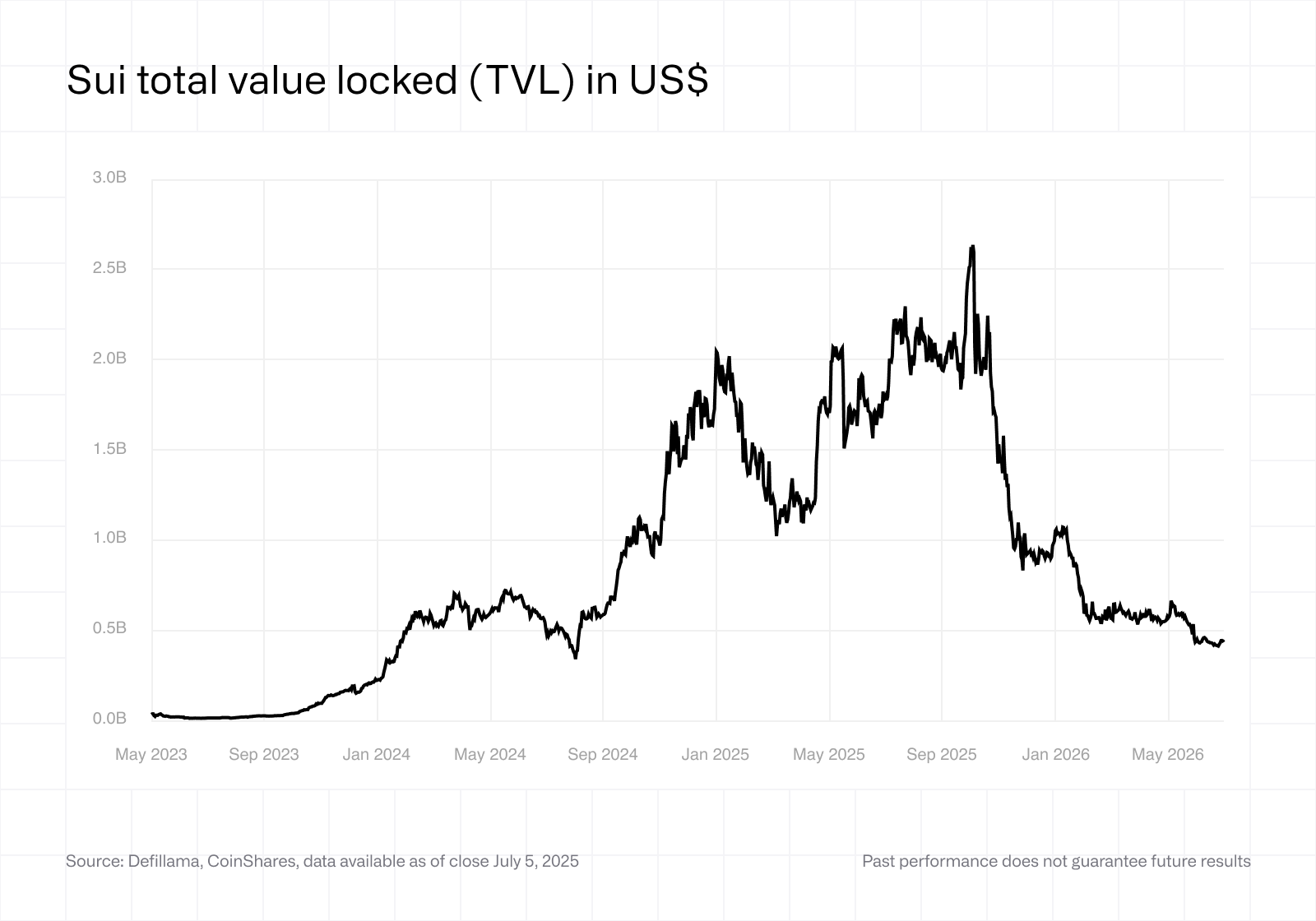
Sui's developer ecosystem grew quickly through 2025, with TVL on the network peaking at $2,64 billion on 9 October 2025 before falling to $568 million by 31 March 2026 and $414 million by 30 June 2026.2 That decline is easily understandable as it reflects a combination of the broader market downturn, the aftermath of notable DeFi exploits on the network, and token unlock pressure on the SUI price, which affects TVL when measured in USD. The underlying developer activity and number of protocols remain significant, but the headline TVL number tells a more cautious story than 2025 coverage suggested.
DEXs on Sui: DeepBook and Cetus
DeepBook is Sui's native on-chain order book, built directly into the network's infrastructure rather than deployed as a separate application. It's designed as a foundational liquidity infrastructure for the whole ecosystem: other apps and aggregators plug into it to access deep, efficient markets. Think of it less as a product you'd use directly and more as the plumbing that makes trading on Sui work smoothly.
Cetus is the largest DEX by trading volume on Sui, using a concentrated liquidity model — the same approach as Uniswap V3 on Ethereum — which lets liquidity providers allocate capital within specific price ranges, making markets more efficient and reducing slippage for traders. Cetus has processed over $110 billion in cumulative trading volume.
Bridges: Wormhole and Axelar
Sui doesn't exist in isolation, assets regularly move between it and other blockchains. The two main bridges are:
Wormhole connects Sui to Solana, Ethereum, and other major chains, supporting both token transfers and NFTs. It's one of the most widely used cross-chain protocols in crypto.
Axelar provides a more infrastructure-grade bridging solution, with a focus on security and developer tooling for building cross-chain applications. It's increasingly used by projects that need reliable interoperability rather than just one-off asset transfers.
Both come with the usual bridge caveats: they introduce a separate trust assumption from the underlying chains, and bridge exploits have been a significant source of losses across the industry. More on that in the risks section below.
Industry applications
Decentralised Finance (DeFi)
Beyond trading, Sui has a growing suite of lending and yield protocols. Suilend has become one of the anchor lending platforms on the network, while Scallop and others offer borrowing and yield products. Stablecoins are a meaningful part of the network: total stablecoin supply on Sui stood at $474,7 million on 30 June 2026, with USDC native to the chain and the USDsui stablecoin launched in early 2026.1 The economics behind that activity have thinned. Network fees, all of which the protocol retains, totalled $8,75 million across 2025 but only $1,20 million over the first half of 2026.3 Daily active addresses averaged 879,106 in 2025 and 267,767 over the first half of 2026, standing at 120,554 on 30 June.
Sui's DeFi sector has attracted growing institutional interest through 2025, with regulated investment products launching in the US market and major financial infrastructure providers integrating the network. That kind of mainstream financial recognition is relatively rare for an ecosystem less than three years old.
Gaming and Web3 innovations
Gaming is one of Sui's most explicit design targets. The object-centric model is a natural fit: in a game, every item, character, and achievement is an asset with an owner, and Sui handles those natively without needing complex smart contract workarounds. Dynamic NFTs (assets that can change state based on in-game actions) work particularly well on Sui's architecture.
Mysten Labs has also built Walrus, a decentralised storage layer designed to handle the large files that games and media applications need. Combined with zkLogin — which lets users log in with a Google or Apple account and get a wallet created automatically, without ever seeing a seed phrase — the onboarding experience is significantly more accessible than most Web3 applications.
Mysten Labs, in partnership with Playtron, launched the SuiPlay0X1 in early 2026, a handheld gaming device designed to run both traditional PC games via Steam and Epic, and Sui-native blockchain games, with wallet and asset management built into the OS. The ambition is clear: make Web3 gaming feel as seamless as any other handheld. Early user feedback suggests the software ecosystem is still catching up.
FAQ
Is SUI a good crypto?
That depends entirely on what you mean by "good" and what you're looking for. As a network, Sui has genuine technical advantages: fast, cheap, and well-designed for a range of applications. Its ecosystem has grown quickly, and institutional interest (ETFs, CME futures, major partnerships) suggests it's being taken seriously beyond the retail speculation crowd.
As an investment, SUI has real strengths but also real risks: monthly token unlocks create ongoing sell pressure, the DeFi ecosystem has already seen notable exploits, and it faces stiff competition from Solana, Ethereum, and other Layer-1s.
Is Sui the same as SUI (State Unemployment Insurance) payroll tax?
No, it is completely unrelated. SUI the payroll tax is a US employer tax that funds state unemployment benefit programmes. SUI the cryptocurrency is the native token of the Sui blockchain. They share an acronym and nothing else.
What are the main risks to watch with Sui?
There are four worth understanding:
Smart contract risk: Sui's DeFi ecosystem is young and growing fast. Fast-growing DeFi tends to attract exploits. In May 2025, Cetus, the largest DEX on Sui, suffered a major exploit. Volo, a liquid staking protocol, was hit for $3.5 million in early 2026. These aren't unique to Sui, but they're a reminder that TVL growth and security maturity don't always move at the same pace. Stick to audited protocols and don't put more in any single DeFi position than you're prepared to lose.
Bridge risk: Moving assets between Sui and other chains involves third-party bridges like Wormhole and Axelar. Bridges have historically been one of the most common vectors for large-scale hacks in crypto. Use them carefully and only with well-established, audited providers.
Validator concentration: Delegated PoS systems can become more centralised over time if staking rewards flow disproportionately to a few large validators. It's worth watching whether Sui's validator set remains diverse.
Token unlocks: A large portion of SUI's total supply is still vesting: roughly 60% of the 10 billion total supply was not yet in circulation as of 30 June 2026, with 4,03 billion SUI circulating1. These unlock on a schedule, and each unlock event can add sell pressure to the market. The effect is visible in the market capitalisation chart above, where market value rose during periods when the price did not. You can track the unlock calendar on sites like TokenUnlocks.
Is SUI better than ETH?
"Better" does not really have a meaning there: they're built for overlapping but not identical things.
Ethereum is the most established smart contract platform. It has the deepest liquidity, the largest developer ecosystem, the most battle-tested protocols, and the strongest institutional infrastructure. Its downsides are well-known: fees can be high during congestion, and it's slower than newer chains by design.
Sui is faster and cheaper at the base layer, and its object model offers genuine architectural advantages for certain use cases, particularly gaming and high-frequency applications. Its ecosystem is growing rapidly but is still smaller and less mature than Ethereum's. Many of the most important DeFi primitives that have been running on Ethereum for years are still early-stage on Sui.
The more useful framing: Ethereum is where most of the existing value and infrastructure lives. Sui is where some of the most interesting new infrastructure is being built. They're not mutually exclusive.
Source
1. Token Terminal, SUI market, fee, active address and stablecoin data, figures at 30 June 2026
2. DefiLlama, Sui chain TVL, at 30 June 2026
Published onMay 11th, 2026
