


What is Uniswap - UNI guide
 15 min read
Uniswap is the largest decentralised exchange in crypto. It lets anyone swap one token for another without an intermediary holding the funds, matching the orders, or deciding which tokens are allowed to trade.
For its first five years, the protocol and its token were two separate stories. Uniswap processed enormous volume; UNI conferred a vote and nothing else. In December 2025 that changed, and this guide covers both the protocol and what the change means for the token.
In short:
Uniswap replaces the order book with a pool of assets priced by formula, a design called an automated market maker.
It handled $1,01 trillion of trading volume in 2025 and $326,7 billion in the first half of 2026.3
Its share of all decentralised exchange volume rose from 27,6% in 2025 to 39,7% in the first half of 2026, even as absolute volume fell.3
In December 2025, governance passed UNIfication: protocol fees were switched on and 100 million UNI was burned from the treasury.4
Retained revenue went from zero through most of 2025 to $12,92M in the second quarter of 2026 alone.3
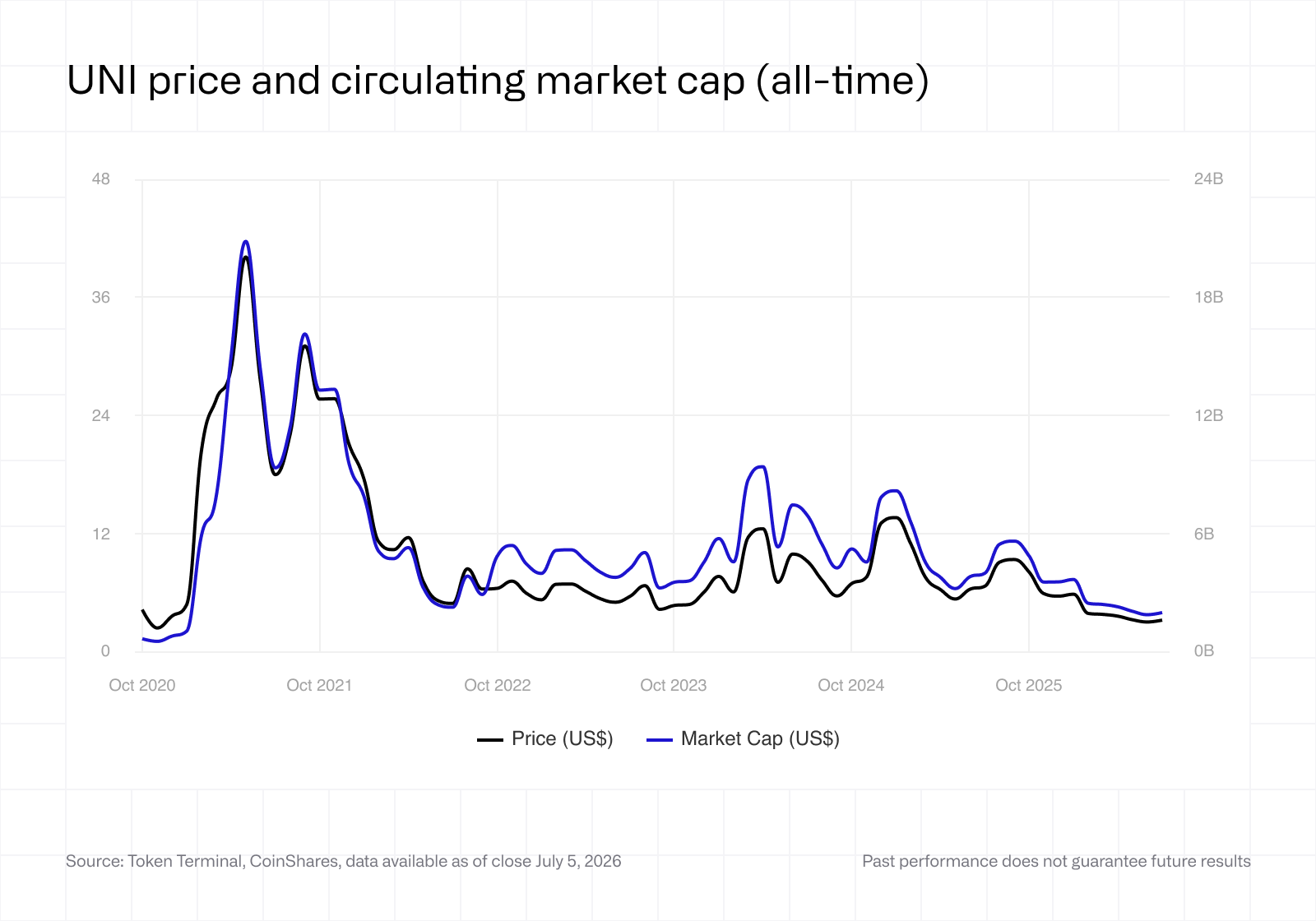
UNI still fell 58,6% in 2025 and a further 50,6% in the first half of 2026.3
What Uniswap is and how it works
Automated market makers, explained
Most exchanges, in crypto and in traditional finance, use an order book. Buyers post the price they will pay, sellers post the price they will accept, and the exchange matches them. Someone has to run that book, and a trade only happens when two people want opposite sides of it.
Uniswap does away with the matching. Instead of trading against another person, you trade against a pool of two assets held in a smart contract, which is a programme that runs automatically when its conditions are met. The pool prices the two assets against each other by formula: as you buy more of one, its price in the pool rises. There is always a price available, because there is always a pool.
The people who supply the assets in those pools are called liquidity providers, and they earn a share of the trading fees in return.
What you can do on Uniswap
Swap tokens. The main use. You need a compatible digital wallet and nothing else, with no account and no approval.
Create a market. If a pair you want to trade does not exist, you can create the pool yourself. Uniswap charges no listing fee, which is why the number of tradeable tokens on it is so large.
Provide liquidity. Deposit both assets in a pool and collect a share of the fees. This carries real risk, because the value of your deposit changes with the price of both assets.
Where Uniswap runs
Uniswap launched on Ethereum and now runs on many chains compatible with the Ethereum Virtual Machine, the software that executes Ethereum's programmes. It also operates its own Layer 2 network, Unichain, covered further down.
What UNI is for
Governance
UNI holders vote on proposals: how the treasury is spent, which fee settings apply, and how the protocol develops. Voting is delegated in practice, so a small number of large holders and delegates carry most of the weight.
Fee capture and the UNI burn
This is the part that changed. From 2020 to 2025, all trading fees went to liquidity providers and none to the protocol, so UNI carried a vote but no claim on the money moving through the exchange. A mechanism to change that, the "fee switch", existed in the code and was debated for years without being turned on.
In December 2025, governance passed a proposal called UNIfication. It switched on protocol fees, directed them to buying and burning UNI, burned 100 million UNI held in the treasury, and folded the Uniswap Foundation's teams into Uniswap Labs. Uniswap Labs also removed its own fees from its interface, wallet and API.4
The effect shows up quickly in the accounts. Users have always paid fees on Uniswap; what changed is how much of them the protocol keeps.Two things follow. UNI now has a mechanism that ties token supply to protocol usage, which it did not have before. And the amounts, while real, are small against the token's market value: $23,65M retained across the first half of 2026 against a market capitalisation of $1,73 billion at the end of June.3
Supply
UNI launched in September 2020 with a total supply of one billion tokens. Circulating supply was 621,211,561 on 30 June 2026.3 The 100 million UNI burned in the UNIfication proposal came from the treasury, which sits outside circulating supply, so the burn reduced the total rather than the circulating figure. Circulating supply fell from over 629,827,000 at the end of December 2025 to slightly over 617,657,000 at the end of January 2026.3
Market performance
UNI traded at $2,78 on 30 June 2026, for a circulating market capitalisation of $1,73 billion.3 The token and the protocol have moved in opposite directions. Uniswap's share of decentralised exchange volume rose, and its retained revenue went from nothing to $12,9 million in a quarter, while UNI lost half its value in six months. Either the market has not yet priced the fee switch, or it has, and concluded that roughly $24 million a half-year does not support a $1,7 billion valuation. The second reading is arithmetically the easier one to defend.
The protocol's numbers
Trading volume and market share
Uniswap handled $1,01 trillion of trading volume in 2025 and $326,7 billion in the first half of 2026.3 Volume fell, but the wider decentralised exchange market fell faster: Uniswap's share went from 27,6% in 2025 to 39,7% in the first half of 2026.3 It is taking a larger slice of a smaller market.
Total value locked
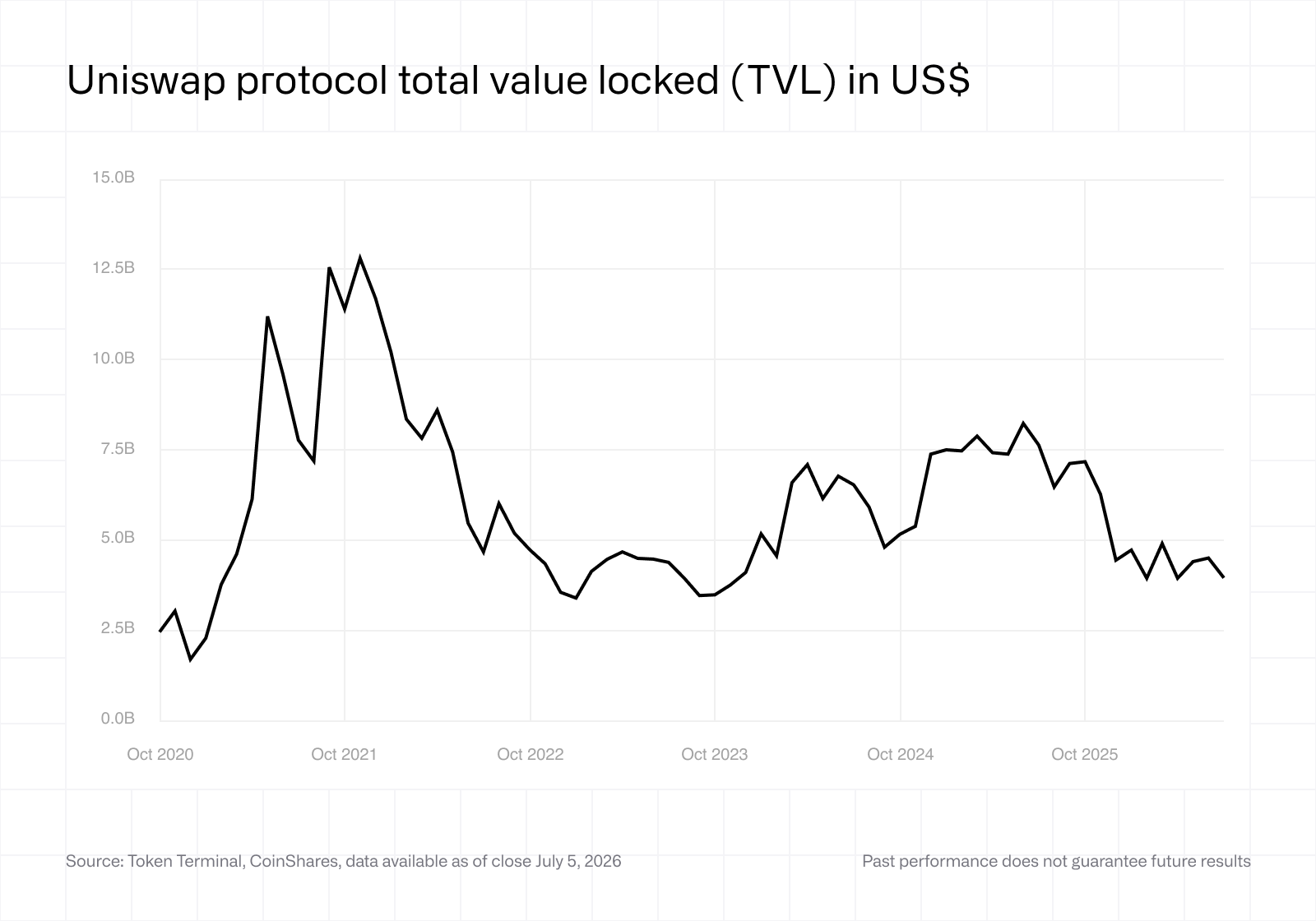
Total value locked, meaning the value of assets sitting in Uniswap's pools, was $4,11 billion on 30 June 2026.3 That is above the $3,96 billion reported in late 2025 and well below the 2021 peak. For an exchange, this figure matters directly: deeper pools mean less price slippage on large trades.
Active users
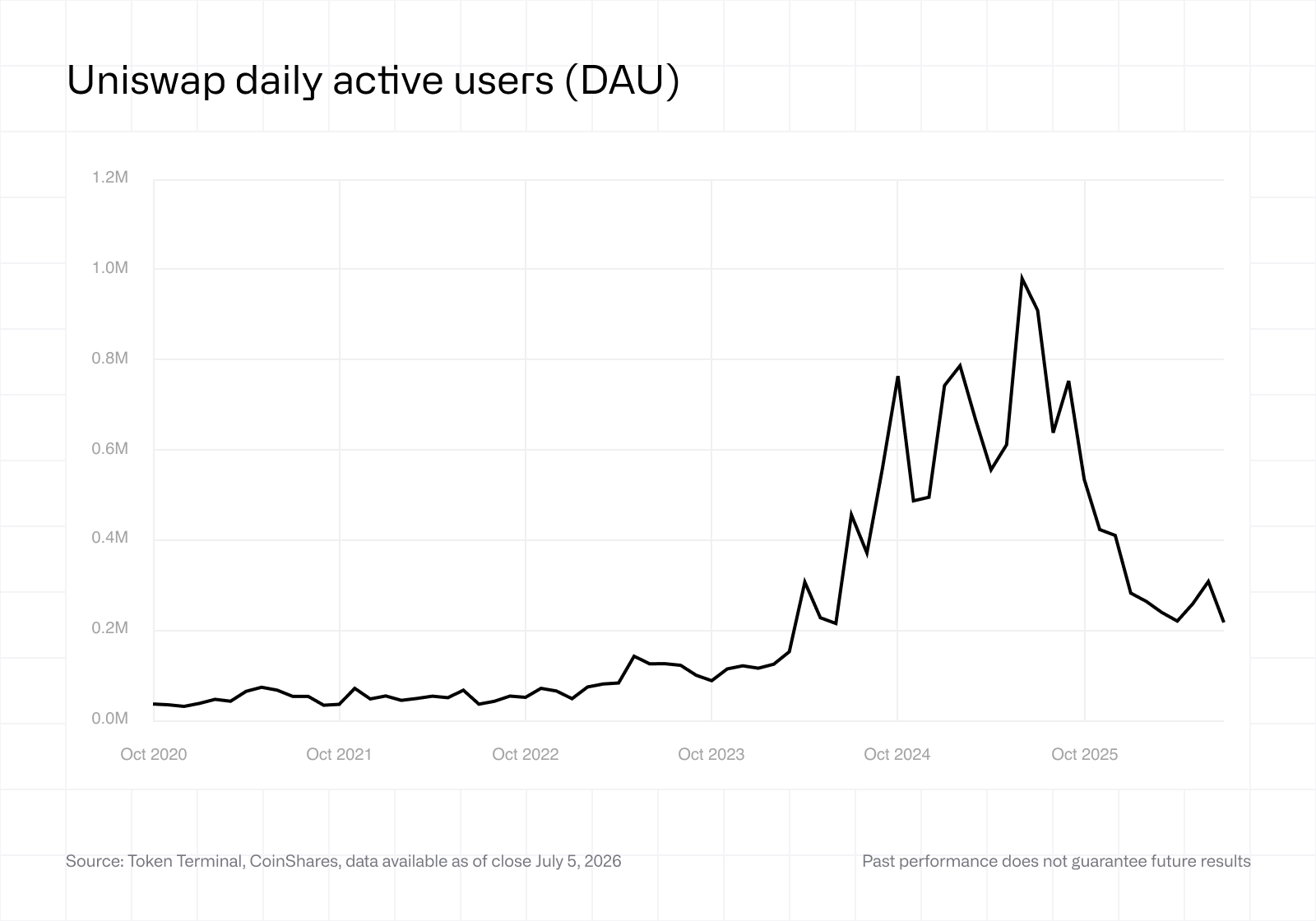
Uniswap recorded 235,984 daily active addresses on 30 June 2026, down from around 355,000 in late 2025 and from a peak near one million.3 The figure counts fee-paying addresses rather than people, and one user may hold several.
History and upgrades
November 2018: Uniswap v1 launched at Devcon, Ethereum's main developer conference. Hayden Adams, a former Siemens engineer, built it after Vitalik Buterin sketched the idea of trading tokens through smart contracts in a 2016 Reddit post.
August 2020: v2 added price oracles, which feed outside data into contracts, and flash swaps.
September 2020: UNI launched.
May 2021: v3 introduced concentrated liquidity, letting providers commit capital to a chosen price range instead of the whole curve, plus multiple fee tiers.
April 2023: cumulative trading volume passed $1,5 trillion.
August 2023: Uniswap deployed on its first Layer 2 network, Base.
January 2025: v4 launched, adding customisable pools through "hooks", dynamic fees, and cheaper handling of ether.
February 2025: Unichain launched.
December 2025: UNIfication passed, switching on protocol fees and burning 100 million UNI.4
Unichain, eighteen months on
Unichain is Uniswap's own Layer 2, built on the OP Stack and therefore part of the Superchain alongside Coinbase's Base and Kraken's Ink. It was designed specifically for trading, with faster settlement and lower costs than Ethereum itself.
The traction so far is modest. Unichain held $246,7 million of value on 30 June 2026 and recorded 2,345 daily active addresses, averaging 3,569 a day over the first half of the year. It generated $115,253 in fees across the whole half.3 That is a small fraction of Uniswap's activity, which still runs mostly on Ethereum and other established chains. Launching a chain and filling it are separate problems, and eighteen months in the second one is unresolved.
Strengths and limitations
Strengths
Uniswap is the clear leader among decentralised exchanges and gained share through a falling market. Anyone can list a token without permission, which is why its range of tradeable assets is unmatched and why network effects have held for six years. Users keep custody of their own funds throughout, which removes the failure mode that took down FTX. And since December 2025 the token has a mechanism connecting protocol usage to its own supply.
Limitations
The token still does not capture much. Retained revenue of $23,65M in the first half of 2026 is real money but modest against a $1,73 billion market capitalisation, and the market has so far priced it accordingly.3
Self-custody is a barrier. Managing a wallet and approving transactions deters people used to an exchange account, and mistakes are irreversible.
Activity is falling. Daily active addresses are down by roughly a third from late 2025 and well below their peak.3
Unichain has not yet found demand, as set out above. And competition is persistent: PancakeSwap, Curve and Raydium all compete for the same volume, and centralised exchanges remain better suited to very large orders, where an order book still gives better execution.
Regulation remains an open question. The US Securities and Exchange Commission closed its investigation into Uniswap Labs in February 2025 without enforcement action, but the treatment of decentralised exchanges is unsettled and turning on protocol fees gives regulators a clearer revenue stream to look at.
Conclusion
Uniswap has spent six years proving that an exchange can work without an operator, and it now runs a larger share of decentralised trading than it did a year ago. The open question was never whether the protocol worked. It was whether owning UNI gave you any part of it.
December 2025 answered that question in principle. The amounts so far, around $24 million retained in six months, answer it only partly in practice. For anyone weighing exposure, the useful distinction is between Uniswap the exchange, which is working, and UNI the token, which now has a claim on that exchange but a small one.
Frequently asked questions
What is Uniswap in simple terms?
A place to swap one crypto token for another without an intermediary. Instead of matching you with another trader, it trades you against a pool of assets held in a smart contract, priced by formula. You keep control of your funds throughout.
What is UNI used for?
Two things. Voting on Uniswap governance proposals, including how the treasury is spent. And, since December 2025, benefiting from protocol fees, which are used to buy and burn UNI, linking token supply to how much the exchange is used.4
Does Uniswap make money now?
Yes, though the protocol only began retaining fees at the end of 2025. Users paid $258,5 million in fees over the first half of 2026, of which the protocol retained $23,65 million.3 Before Q4 2025 it retained nothing, and all fees went to liquidity providers.
What was UNIfication?
A governance proposal passed in December 2025. It switched on protocol fees, directed them to burning UNI, burned 100 million UNI from the treasury, and merged the Uniswap Foundation's teams into Uniswap Labs.4 It is the biggest change to UNI's economics since the token launched.
Is Uniswap safe to use?
The protocol has operated since 2018 without a failure of its core contracts, and you keep custody of your own funds, which removes the risk of an exchange collapsing with them. The risks sit elsewhere: sending funds to the wrong address cannot be undone, anyone can list any token including worthless or malicious ones, and providing liquidity can lose money even when the pool works exactly as designed.
Sources
1 Uniswap Labs, protocol documentation
2 US Securities and Exchange Commission, closure of the Uniswap Labs investigation, February 2025
3 Token Terminal, Uniswap and Unichain market, fee, revenue, volume, TVL and active address data, figures at 30 June 2026
4 Uniswap Foundation and Uniswap Labs, UNIfication proposal and governance vote, November to December 2025
Published onJul 31st, 2023