


What is Toncoin - TON guide
 12 min read
The beginnings of TON
The Open Network (TON) began life as the "Telegram Open Network", a Layer-1 blockchain unveiled by Telegram's founders in 2018 to extend the app beyond messaging. After the SEC challenged Telegram's 2018 private token sale, a US court blocked the distribution of "Grams" in 2020, and Telegram formally withdrew. Independent developers revived the codebase as "The Open Network", and a community-run TON Foundation brought the mainnet online while Telegram continued separately as a company.
That separation proved temporary. In April 2026, Telegram took over the TON Foundation's primary responsibilities and became the network's largest validator under its "Make TON Great Again" (MTONGA) program, formally reuniting the blockchain with the company that originally conceived it. Telegram staked 2.2 million GRAM (then still named TON) to operate as a primary validator on April 30, 2026.1 Governance remains partly community-driven via validator voting on chain configuration, but Telegram's role as principal operator gives it significantly more influence over the network's direction. In June 2026, Toncoin (TON) was rebranded as Gram (GRAM) following a community vote, marking a return to the digital asset’s name as included in the original whitepaper.
Ecosystem investment has also arrived from third parties, most notably Pantera Capital, which called GRAM (then purchased under the ticker TON) its "largest investment ever" in 2024.2
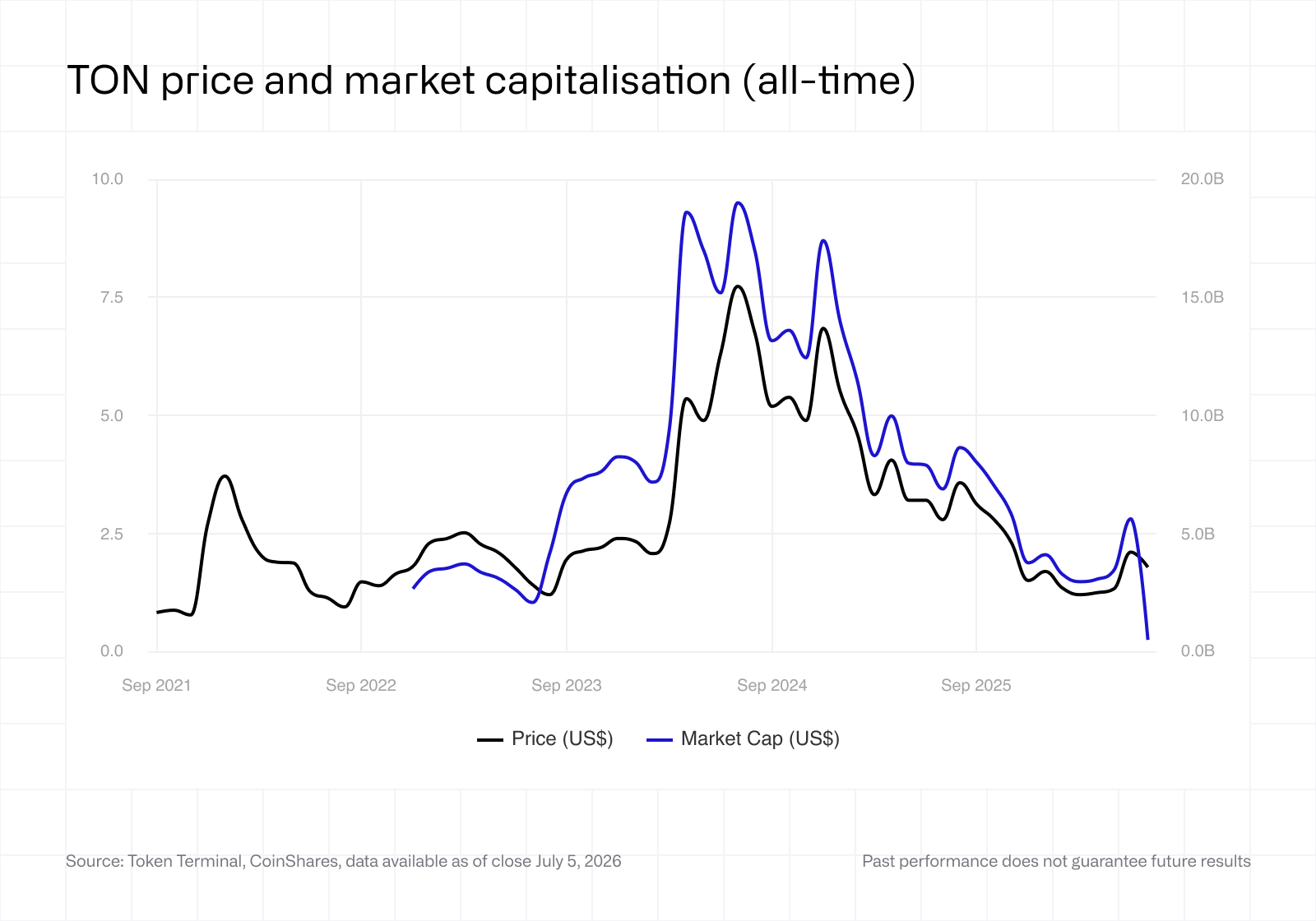
As of 30 June 2026, GRAM traded at $1,49, with a circulating market capitalisation of $4,05B and a fully diluted value of $7,78B.
How the TON network works
Architecture
TON describes itself as a "blockchain of blockchains". A masterchain stores protocol state and validator coordination; multiple workchains host applications; each workchain can split into shardchains to parallelise load. This "infinite sharding" model is designed for horizontal scale, distinguishing TON from monolithic Layer-1s like Solana that scale by raising hardware requirements rather than partitioning the chain.
Consensus and finality
TON uses proof-of-stake validation with rotating validator sets elected in cycles. Validators vote to finalise blocks and can update on-chain configuration parameters via the Elector contract. The Catchain 2.0 upgrade, activated on 9 April 2026, cut block times from approximately 2.5 seconds to roughly 400 milliseconds, with finality measured in under one second.4 A subsequent late-April upgrade reduced base transaction fees by approximately sixfold to around $0.0005, pushing TON's per-transaction cost competitive with Solana's fee floor.
Performance
Public stress tests, audited in real time, have demonstrated six-figure transactions per second on a test network with hundreds of validators and extensive sharding, illustrating headroom for consumer applications while maintaining low fees. Testnet results should not be confused with sustained mainnet throughput, but they indicate the architecture has runway as adoption grows.
How TON compares with other blockchains
TON's most obvious distinguishing feature is distribution. Embedded within Telegram, the network has direct access to a user base of more than one billion people without requiring users to download a separate wallet or learn a new interface.
Against Ethereum, TON emphasises low latency for consumer actions (near-instant finality, minimal fees), while Ethereum focuses on rollup-centric scaling and broader neutrality with a substantially larger developer ecosystem. Against Solana, TON's sharding architecture takes a different scaling path: where Solana scales vertically through performance, TON scales horizontally through partition. Against Bitcoin, the comparison is mostly orthogonal: Bitcoin is store-of-value infrastructure, TON is consumer-facing programmable infrastructure.
What is Gram (formerly Toncoin) used for?
Transaction fees
Users pay fees in Gram to send transactions and interact with applications. A portion of fees is burned per a community mechanism approved in 2023 to offset issuance. Following the April 2026 fee reduction, per-transaction costs have fallen to roughly $0.0005, with Durov publicly indicating most transactions may eventually move to zero commission.
Staking and security
Validators stake Gram and earn rewards from a combination of new issuance and transaction fees. Telegram's entry as the largest validator in April 2026 reshaped the staking landscape: staking inflows reached approximately $192 million in the week following the announcement, the strongest single-week inflow in TON's history.
Governance
Validators vote on network parameters, including configuration changes routed through the Elector contract. Governance in TON is concentrated at the validator level rather than dispersed across token holders, which becomes more consequential now that Telegram operates the largest validator.
Ecosystem payments
Within Telegram, TON powers Mini Apps and on-platform payments. Telegram has stated that Gram is the exclusive non-fiat payment method for Telegram services and that TON is the exclusive blockchain for Mini Apps, anchoring the asset's utility to the messenger's product roadmap.
Supply
In 2023, validators voted to freeze roughly 1.08 billion GRAM (then TON) in inactive miner wallets for 48 months to improve supply clarity, representing about 20% of supply at the time. As of 30 June 2026, circulating supply stood at 2,70 billion GRAM, a little over half the total.
Ecosystem and use cases
Telegram integration
Telegram's move to become TON's largest validator marks a structural shift for the ecosystem: with the messenger now holding direct influence over the network, what was once an arm's-length partnership becomes a tightly aligned project, anchoring TON's infrastructure roadmap to a billion-user platform.
These developments build on earlier milestones. In July 2025, Telegram rolled out an integrated TON wallet to approximately 87 million users in the United States, significantly increasing Toncoin's visibility and potential adoption within a mainstream audience.
Stablecoins and payments
Stablecoins are a meaningful part of TON's ecosystem. Tether's USDT launched natively on TON in April 2024, alongside XAUT (a gold-backed token from the same issuer), providing a substantial boost to payment liquidity inside Telegram's wallet and across TON's DeFi ecosystem. According to DeFiLlama, as of June 2026 USDT accounts for approximately $580 million out of $728 million of stablecoins circulating on the network, with Ethena's USDe second.5
Decentralised finance
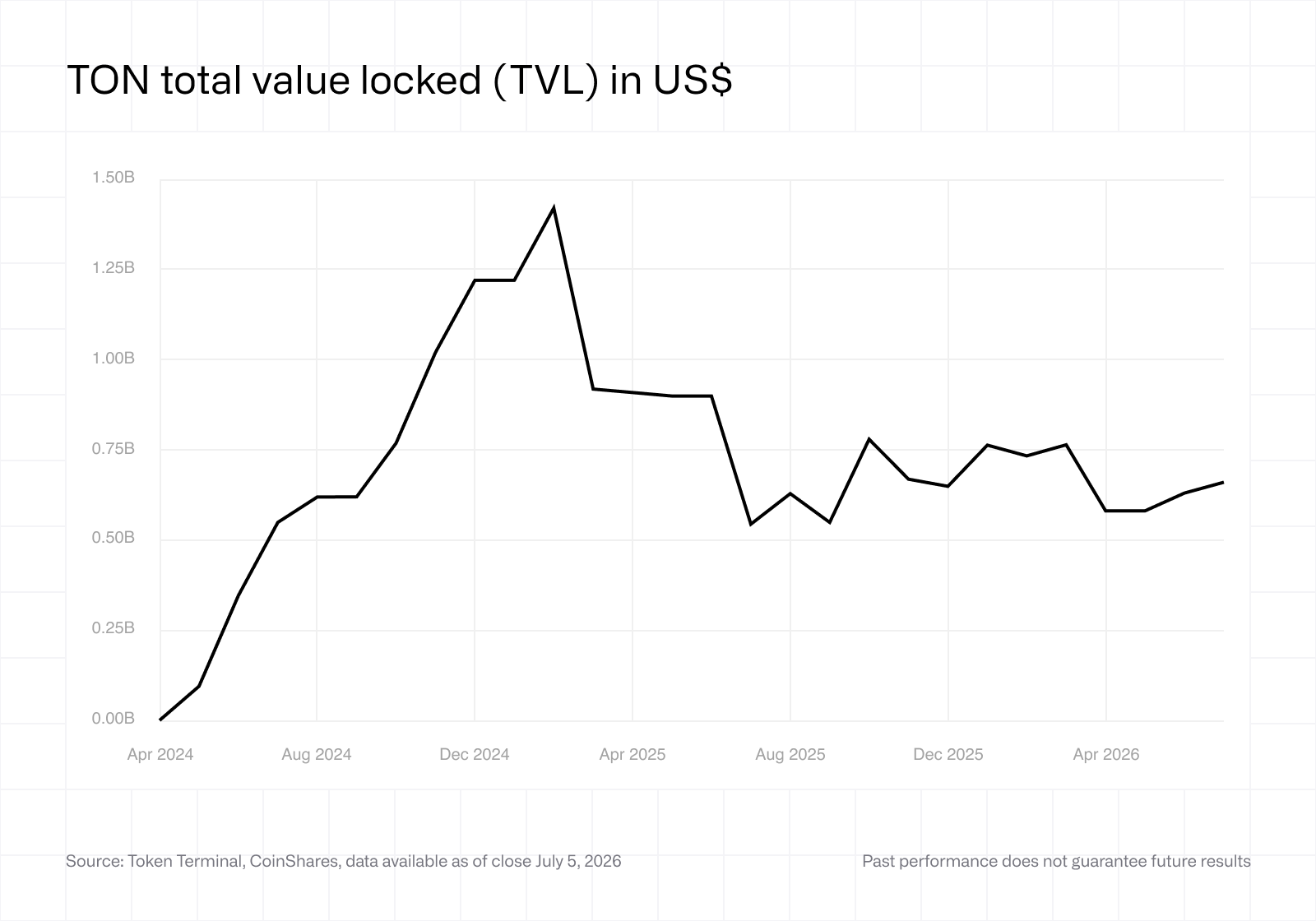
TON's DeFi sector is real but small relative to leading Layer-1 and Layer-2 ecosystems, and has contracted sharply from 2024 peaks. DefiLlama puts TON's DeFi total value locked at $69,1M on 30 June 2026, down from $86,0M at the end of 2025 and far below the record of $778,2M set on 21 July 2024.
In April 2026, Wallet in Telegram launched perpetual futures trading for more than 150 million users through an integration with Lighter, a decentralised exchange running on a custom ZK-rollup on Ethereum with on-chain order matching and liquidations. The feature brings leveraged derivatives into one of the largest consumer-facing distribution channels in crypto: users can open long or short positions on more than 50 assets including BTC, Toncoin, tokenised equities, ETFs, oil, and gold, with leverage of up to 50x available through an integrated custodial wallet.
Gaming and consumer applications
Gaming has been a significant part of TON's growth story. Between 2024 and 2025, tap-to-earn games such as Hamster Kombat and Notcoin attracted tens to hundreds of millions of users. Long-term sustainability has proven limited: by April 2026, Hamster Kombat had shed approximately 96% of its users and its token had lost over 95% of its value from peak. The game remains technically active but has yet to demonstrate a viable path beyond the original tap-to-earn mechanic.
Developer interest in the network has nonetheless held up. In July 2025, The Open Platform (TOP), a toolkit provider for Telegram's crypto infrastructure, became the first TON-focused unicorn after raising $28.5 million in a funding round led by Ribbit Capital with participation from Pantera, signalling continued investor confidence in TON's Mini App stack.
Strengths and limitations
Strengths
TON's distribution advantage is unmatched in crypto: direct access to a billion-user messenger via Mini Apps, native wallets, and in-chat user experience. The sharded proof-of-stake architecture delivers near-instant block times with low fees, well-suited to consumer micropayment use cases. Native USDT support has improved peer-to-peer transfer, commerce, and DeFi liquidity meaningfully.
Limitations
The most pressing risk is regulatory and reputational exposure to Telegram. Pavel Durov was arrested in France in August 2024 and indicted on charges relating to platform complicity in illegal activity. His travel ban was fully lifted on 13 November 2025, though the judicial investigation remains ongoing.7 Any further enforcement action against Telegram has the potential to spill directly onto TON.
Telegram's elevation to largest validator introduces a second risk: meaningful operational centralisation. Telegram's framing is that other large players will follow it into the validator set as a counterbalance, but the network's near-term direction now depends materially on a single private company.
Ecosystem concentration is a third concern. User growth has been led by Mini App virality and gaming, and sustainability beyond hype cycles has not yet been proven. DeFi depth and protocol diversity remain below top Layer-1s and Layer-2s, and have contracted from 2024 peaks.
A fourth is that the network currently earns very little. Protocol revenue for the first half of 2026 was $583,164. Cheap transactions are the product, so low revenue is partly intentional, but it does mean validator economics rest on new issuance rather than on usage. If issuance is ever tightened, something has to replace it.
Main takeaways
TON is carving out a consumer-first lane: low-friction crypto actions embedded inside a mainstream messenger. That distribution is complementary to Bitcoin's store-of-value role and Ethereum's broad developer and DeFi ecosystem. For portfolio construction, TON looks like a thematic bet on mass adoption via Telegram rather than a replacement for Bitcoin or Ethereum. The MTONGA reset has tightened the alignment between Telegram and TON; the test for the second half of 2026 is whether the fee cuts, consensus upgrade, and developer tooling translate into sustained on-chain activity rather than another narrative cycle.
FAQ
Is TON the same as Telegram?
No, but the relationship has tightened sharply in 2026. TON is a Layer-1 blockchain originally created by Telegram's founders in 2018, then spun out and run by an independent foundation after Telegram withdrew in 2020. In April 2026, Telegram returned as TON's largest validator and effectively took over the foundation's primary responsibilities, so while the two are still legally distinct entities, they are now operationally aligned in a way they were not a year ago.
What is Toncoin used for?
Gram has four main uses on TON. First, paying transaction fees, now around $0.0005 per transaction after the April 2026 reduction. Second, staking by validators to secure the network and earn rewards. Third, voting on network parameters via validator governance. Fourth, paying for Telegram services and Mini Apps, where Gram is the exclusive non-fiat payment method.
How does TON differ from Ethereum?
The two networks make different trade-offs. TON prioritises low latency and minimal fees for consumer actions, which suits in-app payments and micropayments. Ethereum focuses on broader neutrality, with a substantially larger developer ecosystem, deeper DeFi liquidity, and more mature institutional infrastructure including spot ETFs. The other major difference is distribution: TON is embedded in Telegram, Ethereum is not embedded in any single consumer product but is part of a larger financial and technological ecosystem.
Why was Toncoin renamed Gram?
Following a community vote in June 2026, the token took the name Gram, which is what Telegram's original 2018 whitepaper called it. The name had been unavailable in practice after a US court blocked the distribution of Grams in 2020. The network is still called TON; only the token name changed, and holders were unaffected.
Sources
1 Pavel Durov, public statements on the MTONGA roadmap, April to May 2026; on-chain validator records
2 Pantera Capital, "TON: Our largest investment ever", panteracapital.com, 5 August 2024
3 Token Terminal, TON market cap, price, and supply data, May 2026
4 TON Foundation and Catchain 2.0 release documentation, 9 April 2026
5 DefiLlama, stablecoin breakdown on TON, May 2026
6 DefiLlama, TON chain TVL, early May 2026
7 Bloomberg / AFP, France lifts travel ban on Pavel Durov, 13 November 2025
Published onMay 18th, 2026
